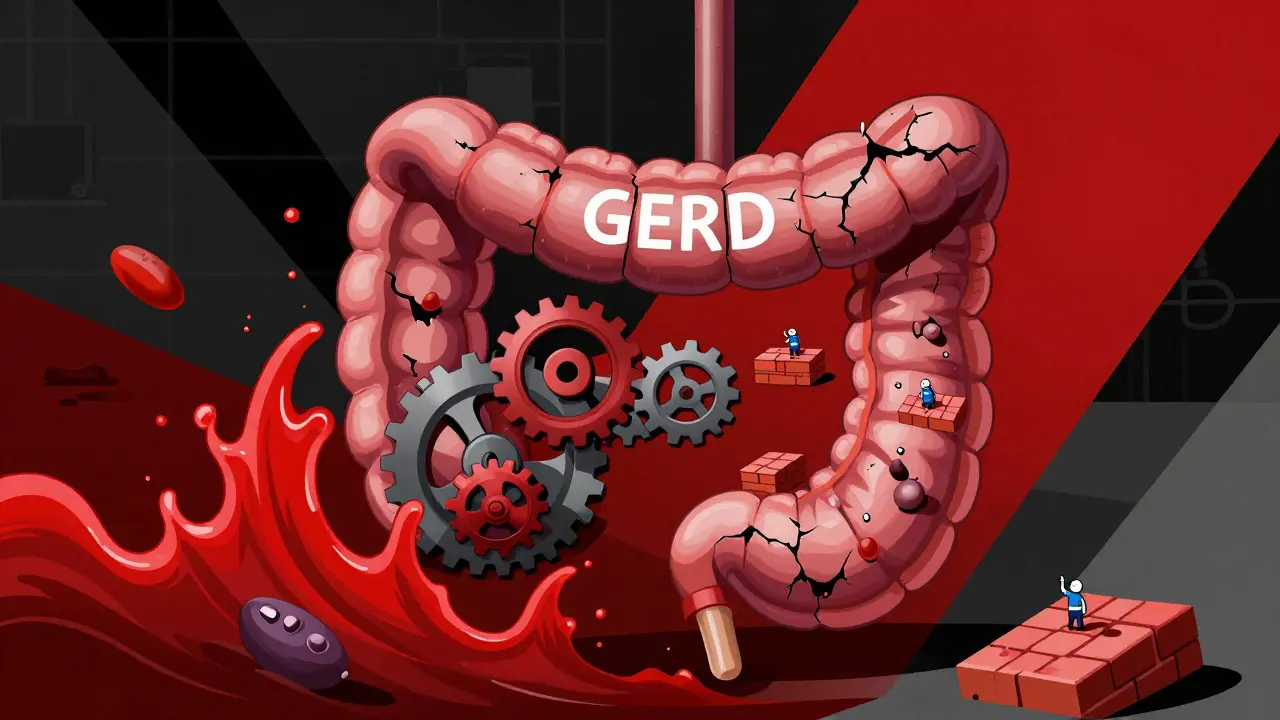
Chronic acid reflux isn’t just uncomfortable-it’s a silent warning sign that could lead to cancer. If you’ve had heartburn for five years or more, especially if you’re a man over 50, overweight, or a smoker, you’re in a higher-risk group for esophageal cancer. Most people don’t realize that what they think is a minor nuisance could be setting the stage for something far more serious. The truth? GERD is the biggest known risk factor for esophageal adenocarcinoma, the most common type of esophageal cancer in the U.S. today.
How GERD Turns Into Cancer
Your esophagus isn’t meant to handle stomach acid. Every time acid backs up into it, the lining gets damaged. Over time, your body tries to protect itself by changing the cells lining the esophagus to look more like stomach cells. This is called Barrett’s esophagus. It’s not cancer-but it’s the only known precursor to it. About 10-15% of people with long-term GERD develop Barrett’s esophagus. Of those, only about 0.2-0.5% per year will go on to develop cancer. That sounds low, but because GERD affects 1 in 5 adults in the U.S., the total number of cases adds up fast.
The progression isn’t random. It’s predictable: chronic GERD → Barrett’s esophagus → dysplasia (pre-cancer) → adenocarcinoma. The longer you have GERD, the higher your risk. Studies show people with GERD symptoms for five or more years have a fivefold increased chance of developing Barrett’s esophagus. And if you’re having symptoms weekly? Your risk of esophageal cancer jumps seven times higher than someone without GERD.
Who’s Really at Risk?
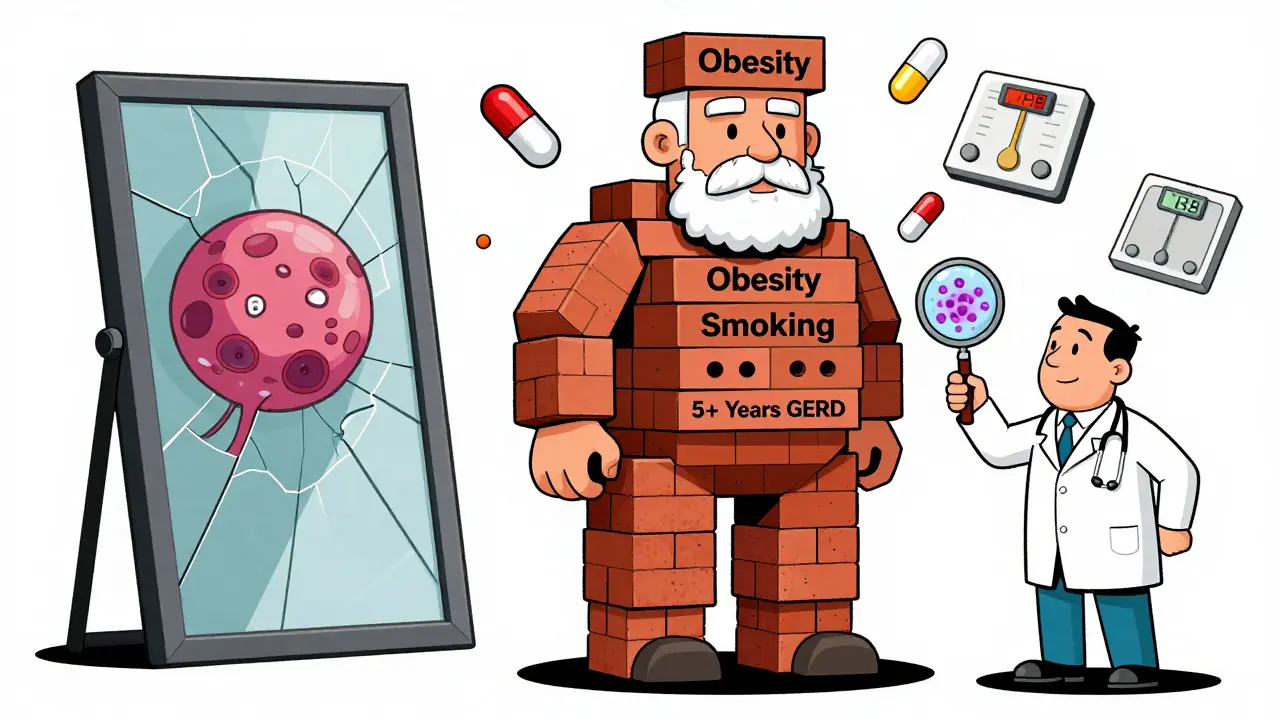
Not everyone with GERD gets cancer. But certain combinations of factors make it much more likely. The biggest red flags are:
- Male sex - Men are 3 to 4 times more likely than women to develop esophageal adenocarcinoma.
- Age over 50 - 90% of cases occur in people over 55.
- White, non-Hispanic ethnicity - White Americans have three times the rate of adenocarcinoma compared to Black Americans.
- Obesity - A BMI of 30 or higher doubles or triples your risk. Fat around the abdomen pushes stomach contents upward.
- Smoking - Current or past smokers have 2 to 3 times the risk.
- Family history - If a close relative had esophageal cancer, your risk goes up.
Put three or more of these together, and your risk isn’t just higher-it’s significantly elevated. For example, a 60-year-old white male with a 15-year history of GERD, a BMI of 32, and a smoking history has a risk level that doctors take very seriously.
The Red Flags That Demand Action
Most esophageal cancer is found too late-75% of cases are diagnosed at advanced stages. That’s because early symptoms are easy to ignore. But some signs are too clear to overlook:
- Dysphagia - Trouble swallowing, especially solid foods at first, then liquids. This is the most common symptom, present in 80% of cases at diagnosis.
- Unexplained weight loss - Losing more than 10 pounds in six months without trying is a major red flag.
- Food getting stuck - Feeling like food is lodged in your chest or throat, even if you didn’t eat too much.
- New or worsening heartburn after age 50 - If you’ve never had acid reflux before and it starts after 50, or if it suddenly gets worse, get checked.
- Chronic hoarseness or cough - A voice that won’t clear up or a cough lasting over two weeks can be from acid irritating your vocal cords.
These aren’t vague symptoms. They’re measurable, clinical warning signs. If you’re over 50 and have had GERD for five years or more, and you’re now having trouble swallowing or losing weight, don’t wait. See a doctor. Endoscopy can detect Barrett’s esophagus before it turns cancerous.
What You Can Do to Lower Your Risk
The good news? You can cut your risk dramatically with simple steps.
Quit smoking. Within 10 years of quitting, your esophageal cancer risk drops by half. It’s one of the most effective things you can do.
Loose the weight. Losing just 5-10% of your body weight reduces GERD symptoms by 40% in obese people. Less pressure on your stomach means less acid backing up.
Limit alcohol. Heavy drinking (three or more drinks a day) increases a different type of esophageal cancer-squamous cell carcinoma. But for GERD-related cancer, moderation matters. Stick to one drink a day for women, two for men.
Treat GERD properly. Over-the-counter antacids won’t cut it if you have chronic reflux. Proton pump inhibitors (PPIs), taken daily and consistently for five or more years, reduce cancer risk by 70% in people with Barrett’s esophagus. But you need a doctor’s guidance-long-term PPI use isn’t risk-free either.
Get screened. If you’re a white male over 50 with chronic GERD (5+ years) and at least two other risk factors (obesity, smoking, family history), guidelines say you should have an upper endoscopy. Yet only 13% of high-risk people do. That’s a gap that’s costing lives.
What Screening Looks Like
Endoscopy is the gold standard. A thin, flexible tube with a camera goes down your throat to look at your esophagus. If your lining looks abnormal, the doctor takes small tissue samples (biopsies) to check for Barrett’s esophagus or early cancer. Newer techniques like narrow-band imaging and confocal laser endomicroscopy make it easier to spot changes in real time.
There’s also a promising new tool called the Cytosponge. It’s a pill you swallow with a string attached. Once it reaches your stomach, it expands into a sponge, collects cells from your esophagus as it’s pulled back out, and those cells are tested for Barrett’s. In a 2022 Lancet study, it detected 79.9% of cases-nearly as good as endoscopy, but cheaper and less invasive. It’s not yet widely available, but it’s coming.
Doctors are also using tools like the BE MAPPED calculator, which uses your age, sex, BMI, smoking history, GERD duration, race, and family history to estimate your personal risk-with 85% accuracy. If your score is high, screening is strongly recommended.
Why This Matters Now
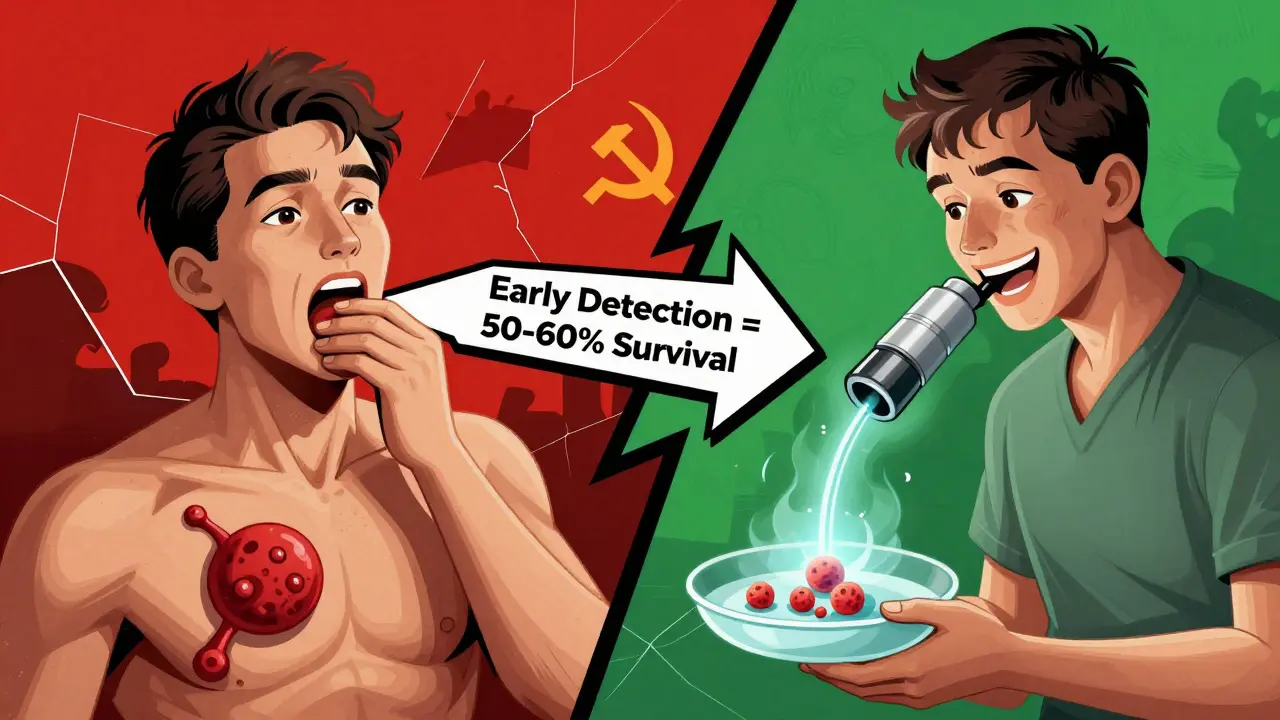
Since 1975, cases of esophageal adenocarcinoma have jumped 850%. Why? Obesity rates have more than doubled. GERD is more common than ever. And while squamous cell cancer (linked to smoking and alcohol) is declining, adenocarcinoma is rising fast. In 2023, there were over 21,000 new cases in the U.S.-and nearly 17,000 deaths. The five-year survival rate is only 21% overall. But if caught early, before it spreads, that number jumps to 50-60%.
This isn’t a distant threat. It’s happening now. And it’s preventable-if you know the signs.
What to Do Next
If you’ve had frequent heartburn for five years or more, especially with any of the other risk factors, talk to your doctor about screening. Don’t wait until you’re having trouble swallowing. By then, it may be too late.
Keep a symptom log: How often do you get heartburn? Do you wake up at night? Have you lost weight? Is swallowing harder than it used to be? Bring this to your appointment. It helps your doctor assess your risk faster.
And if you’re not in a high-risk group but still have GERD? Treat it. Lifestyle changes, proper medication, and regular check-ins can stop the progression before it starts. You don’t need to live with constant burning. And you definitely don’t need to risk cancer for it.
Can GERD cause cancer even if I’m on medication?
Yes. Medications like PPIs reduce acid and lower cancer risk by up to 70% if taken consistently for five or more years-but they don’t eliminate it entirely. If you’ve had GERD for over five years, especially with other risk factors, you still need screening. Medication controls symptoms but doesn’t reverse existing cell changes in the esophagus.
Is Barrett’s esophagus the same as cancer?
No. Barrett’s esophagus is a precancerous condition where the lining of the esophagus changes due to long-term acid exposure. It’s not cancer, but it’s the only known step before esophageal adenocarcinoma develops. Most people with Barrett’s never get cancer, but regular monitoring is essential to catch any early changes.
How often should I get screened for Barrett’s esophagus?
If you’re diagnosed with Barrett’s esophagus without dysplasia (abnormal cells), guidelines recommend an endoscopy every 3-5 years. If low-grade dysplasia is found, you’ll need follow-ups every 6-12 months. High-grade dysplasia often requires treatment to remove abnormal tissue before cancer develops. Screening frequency depends on your individual risk and what your biopsy shows.
Can I get screened if I’m not white or male?
Yes. Current guidelines focus on white males over 50 because they have the highest risk-but anyone with long-term GERD and other risk factors (obesity, smoking, family history) should discuss screening. Women and non-white individuals can still develop Barrett’s esophagus and esophageal cancer, even if the rates are lower. Don’t assume you’re not at risk just because you don’t fit the classic profile.
What if I have GERD but no symptoms?
Silent GERD is real. Some people have damage to their esophagus without classic heartburn. They might only have a chronic cough, hoarseness, or a lump feeling in the throat. If you have multiple risk factors and have had GERD for five or more years-even if you don’t feel it-you should still consider screening. Symptoms aren’t always a reliable guide to damage.
Does losing weight really help reduce cancer risk?
Yes. Losing 5-10% of your body weight can reduce GERD symptoms by 40% and lower pressure on your stomach, which cuts acid reflux. Studies show that sustained weight loss can slow or even reverse early Barrett’s changes. It’s one of the most effective, drug-free ways to reduce your cancer risk.



Okay but have you ever heard of the FDA secretly approving acid reflux meds that actually cause Barrett’s esophagus? I read this forum post from a guy who worked at a pharma lab-he said they’ve been tweaking PPIs since 2010 to keep people dependent. The ‘70% risk reduction’? That’s just the number they want you to see. Real doctors know the truth: your esophagus doesn’t need ‘repair,’ it needs detox. I went off PPIs and did a lemon-water cleanse for 30 days-my heartburn vanished. Coincidence? I think not.
January 30Beth Cooper