Acetaminophen Daily Intake Tracker
Check labels for "Acetaminophen", "APAP", or "Paracetamol".
Today's Log
Warning Signs of Toxicity
- Nausea & Vomiting
- Loss of Appetite
- Pain in Upper Right Abdomen
- Confusion or Jaundice (Yellow skin/eyes)
It sounds harmless enough. You have a headache, so you pop two pills. Then your back hurts, so you take some more later that day. Maybe you also took a cold medicine at night because you felt congested. By morning, you might not feel great, but you probably don’t realize you’ve just pushed your liver into crisis mode.
This is the quiet danger of acetaminophen, a widely used pain reliever and fever reducer that becomes toxic when doses are miscalculated or combined unknowingly from multiple sources. It is the leading cause of acute liver failure in the United States. Every year, roughly 1,600 cases of acute liver failure are directly linked to this drug, resulting in about 500 deaths. The scary part? Most of these aren’t intentional overdoses. They happen because people simply don’t know how much they are taking.
Key Takeaways
- The maximum daily limit for healthy adults is 4,000 mg, but those with liver disease or who drink alcohol should cap it at 2,000-3,000 mg.
- Acetaminophen hides in over 600 medications, including prescription painkillers like Vicodin and OTC cold remedies like NyQuil.
- Alcohol consumption drastically lowers the safety threshold, making even standard doses potentially dangerous.
- Acetylcysteine (NAC) is the antidote and works best if given within 8 to 10 hours of ingestion.
- Always check labels for "APAP" or "paracetamol" to avoid accidental double-dosing.
Why Acetaminophen Is So Dangerous to the Liver
To understand why this common drug causes such severe damage, you need to look at how your body processes it. When you take acetaminophen, your liver handles most of the work. Normally, the liver uses two main pathways-sulfation and glucuronidation-to break the drug down safely and flush it out through your urine.
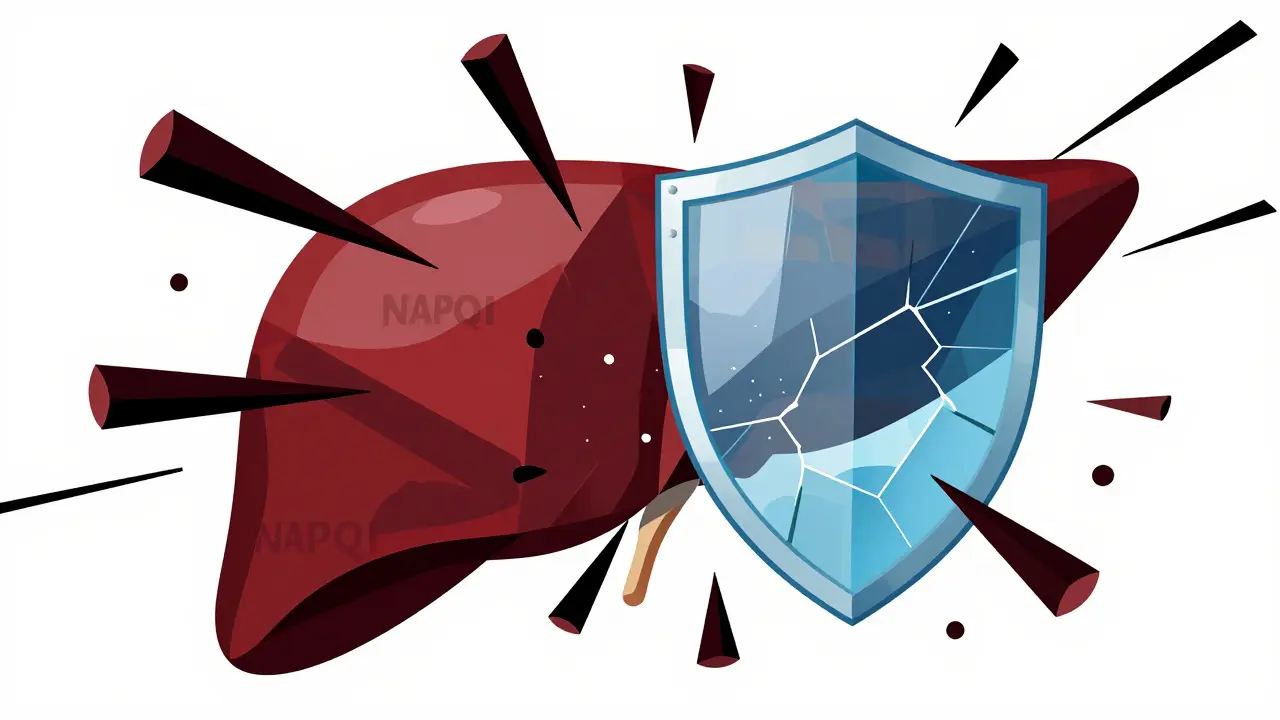
But here is where things go wrong. If you take too much, those normal pathways get saturated. Your liver then switches to a backup system involving enzymes called cytochrome P450. This system creates a toxic byproduct known as N-acetyl-p-benzoquinone imine, or NAPQI. In small amounts, your liver neutralizes NAPQI using a substance called glutathione. Think of glutathione as your liver’s antioxidant shield.
If you keep taking more acetaminophen, you deplete that shield. Once about 70% of your glutathione stores are gone, NAPQI starts attacking liver cells directly. This causes oxidative damage, leading to cell death and eventually liver failure. This process can happen surprisingly fast, which is why timing matters so much in treatment.
The Hidden Sources Problem
The biggest risk factor for accidental overdose isn’t usually someone trying to harm themselves; it’s someone trying to get better. Acetaminophen is present in more than 600 prescription and over-the-counter medications. It is often listed under different names, which makes tracking your total intake difficult.
You might buy a bottle of plain Tylenol for a headache. That’s 500 mg per pill. Later, you catch a cold and take a multi-symptom flu remedy like DayQuil or NyQuil. These often contain acetaminophen too. Then, if you have a toothache, your dentist might prescribe Vicodin or Percocet. Both of those are opioid combinations that include acetaminophen.
Here is a typical scenario that leads to toxicity:
- Morning: Two extra-strength Tylenol pills (1,000 mg).
- Afternoon: One dose of cold medicine containing 650 mg of acetaminophen.
- Evening: Another dose of cold medicine (650 mg).
- Night: Prescription painkiller with 325 mg of acetaminophen.
Total: 2,625 mg in one day. You haven’t hit the 4,000 mg limit yet, but if you repeat this pattern for a few days while drinking alcohol or if you have underlying liver issues, you are walking a very thin line. Always check the "Drug Facts" label on the back of every box. Look for "acetaminophen," "APAP," or "paracetamol."">
Safe Dosing Guidelines: Healthy vs. At-Risk Patients
Knowing the numbers is crucial. For a healthy adult with no liver problems and no alcohol use, the standard medical guideline sets the maximum daily dose at 4,000 milligrams (4 grams). A single dose typically ranges from 325 mg to 1,000 mg, taken every 4 to 6 hours as needed.
However, many manufacturers are now recommending lower limits. For example, Mayo Clinic notes that for Tylenol Extra Strength products, the maximum safe daily dose is actually 3,000 mg. This reflects a shift toward caution rather than pushing the absolute legal limit.
For patients with liver disease, chronic alcohol use disorder, or malnutrition, the rules change completely. These conditions impair the liver’s ability to process the drug and reduce glutathione stores. In these cases, experts recommend capping daily intake at 2,000 mg to 3,000 mg, or avoiding the drug entirely. If you have hepatitis or cirrhosis, you must talk to your doctor before taking any acetaminophen-containing product.
| Patient Group | Max Daily Dose | Key Risk Factors |
|---|---|---|
| Healthy Adults | 4,000 mg (some guidelines say 3,000 mg) | Combining multiple meds, dehydration |
| Liver Disease / Alcohol Use | 2,000 - 3,000 mg (or avoid) | Reduced glutathione, impaired metabolism |
| Children (1-6 years) | Max 80 mg/kg/day | Measurement errors, weight-based dosing |
Alcohol and Acetaminophen: A Deadly Mix
If there is one rule you need to remember, it is this: do not mix alcohol and acetaminophen. Alcohol induces the cytochrome P450 enzymes mentioned earlier. This means your liver produces *more* of the toxic NAPQI metabolite when you drink. At the same time, alcohol depletes your glutathione stores.
So you have a double whammy: more poison being created and less shield available to stop it. Dr. Ke-Qin Hu, a liver specialist, notes that the 4-gram limit becomes significantly lower-as low as 2 grams-when combined with alcohol. Even moderate drinking while taking standard doses can lead to significant liver injury over time. This is why patients with chronic alcohol use disorder are at exceptionally high risk for acetaminophen-induced liver failure.
Recognizing Toxicity and Early Symptoms
In the first 24 hours after an overdose, symptoms can be vague and easy to ignore. You might feel nauseous, vomit, lose your appetite, or experience general malaise. Some people feel perfectly fine initially, which gives a false sense of security. This is dangerous because the liver damage is already occurring silently.
Between 24 and 72 hours, symptoms may improve temporarily, but this is deceptive. During this window, blood tests will show rising levels of liver enzymes (ALT and AST), indicating cell death. After 72 to 96 hours, if untreated, severe liver failure can set in. Signs include jaundice (yellowing of skin and eyes), confusion, bleeding tendencies, and abdominal pain in the upper right quadrant.
If you suspect an overdose, do not wait for symptoms to worsen. Go to the emergency room immediately. Time is the most critical factor in saving your liver.
Treatment: The Role of Acetylcysteine (NAC)
The good news is that acetaminophen toxicity is treatable if caught early. The antidote is acetylcysteine, commonly known as NAC. NAC works by replenishing your liver’s glutathione stores, allowing it to neutralize the toxic NAPQI.
According to clinical guidelines, NAC is highly effective if administered within 8 to 10 hours of ingestion. It can still reduce the severity of liver damage if given within 16 hours. Doctors use a tool called the Rumack-Matthew nomogram to determine if treatment is necessary. This chart plots your blood acetaminophen level against the time since ingestion. If your point falls above the "treatment line" (150 μg/mL at 4 hours), you need NAC.
NAC can be given orally or intravenously. The IV route involves a loading dose followed by maintenance infusions over 20 hours. While NAC is generally safe, it can cause allergic-like reactions, especially with the IV formulation. However, studies show that prior reactions are not a contraindication; doctors can adjust the rate or switch routes to manage side effects.
Prevention Strategies for Everyday Use
Avoiding hepatotoxicity comes down to vigilance. Here is a practical checklist for safe use:
- Read every label. Check all OTC and prescription drugs for acetaminophen content. Look for APAP, paracetamol, or abbreviations.
- Keep a log. If you are taking multiple medications, write down the time and amount of each dose. This prevents accidental double-dosing during long illnesses.
- Use proper measuring tools. For children, never use household spoons. Use the syringe or cup provided with the medication to ensure accurate mg/kg dosing.
- Limit alcohol. Ideally, avoid alcohol completely while taking acetaminophen. If you do drink, stay well below the daily medication limit.
- Consult your doctor. If you have liver disease, eat poorly, or take medications that induce liver enzymes (like certain seizure drugs), ask for personalized dosing advice.
Acetaminophen remains a valuable tool for pain and fever management. But its narrow therapeutic window demands respect. By understanding how it affects your liver and staying aware of hidden sources, you can use it safely without risking your health.
How much acetaminophen is too much for someone with liver disease?
For individuals with pre-existing liver disease, chronic alcohol use, or malnutrition, the maximum daily dose should be reduced to 2,000 mg to 3,000 mg. In some severe cases, doctors may advise avoiding acetaminophen entirely. Always consult a healthcare provider for specific guidance tailored to your condition.
Can I take acetaminophen if I drink alcohol occasionally?
Occasional light drinking may not pose a huge risk if you stay well within the daily limits, but it does lower your safety margin. Alcohol increases the production of toxic metabolites and depletes protective glutathione. To be safe, avoid mixing them, and never exceed 2,000-3,000 mg of acetaminophen on days you consume alcohol.
What are the signs of acetaminophen overdose?
Early signs (within 24 hours) include nausea, vomiting, loss of appetite, and sweating. These symptoms may disappear temporarily, giving a false sense of recovery. Severe symptoms appear after 24-72 hours and include jaundice, confusion, abdominal pain, and bleeding. Seek immediate medical help if you suspect an overdose, even if you feel fine.
Is there an antidote for acetaminophen toxicity?
Yes, acetylcysteine (NAC) is the effective antidote. It works best when administered within 8 to 10 hours of ingestion but can still help reduce liver damage if given up to 16 hours later. Treatment decisions are often based on blood tests and the Rumack-Matthew nomogram.
Why is acetaminophen found in so many medications?
Acetaminophen is added to many combination drugs, such as opioids (Vicodin, Percocet) and cold/flu remedies (NyQuil, Sudafed PE), because it enhances pain relief and reduces fever. Its widespread presence makes unintentional overdose common when patients take multiple medications without checking labels.