
When a generic drug company submits an application to the FDA, they’re not just asking for permission to sell a cheaper version of a brand-name drug. They’re asking the FDA to certify that their product is therapeutically equivalent-same active ingredient, same strength, same dosage form, and same performance in the body. But too often, that application comes back with a deficiency letter. These aren’t polite suggestions. They’re roadblocks. And they cost time, money, and market access.
According to FDA data from 2023 and 2024, more than 70% of all major issues in Abbreviated New Drug Applications (ANDAs) are quality-related. That means the problem isn’t usually about marketing or pricing-it’s about science, documentation, and manufacturing control. The FDA doesn’t reject applications out of frustration. They reject them because the drug might not work the same way as the brand-name version. And that’s not acceptable.
What Exactly Is a Deficiency Letter?
A deficiency letter is the FDA’s formal way of saying, “We can’t approve this yet.” It’s not a rejection. It’s a list of specific, actionable problems that must be fixed before the application can move forward. These letters come after the initial review cycle and are issued by the Center for Drug Evaluation and Research (CDER). They’re detailed, technical, and often overwhelming for companies new to the process.
Before 2003, the FDA used informal notes and recommendations. Today, every deficiency letter follows a strict format. Each issue is numbered, clearly described, and tied to a specific regulatory requirement-usually from the Code of Federal Regulations (CFR) or an FDA guidance document. Missing a single point can delay approval by months, sometimes over a year.
The Top 5 Deficiency Categories (And How They Happen)
Not all deficiencies are created equal. Some are rare. Others show up in nearly every other application. Based on FDA’s FY2023-2024 data, here are the five most common problems-and why they keep happening.
1. Dissolution Method Issues (23.3% of applications)
Dissolution testing measures how quickly a drug dissolves in the body. It’s one of the most important ways the FDA confirms bioequivalence. But many companies use outdated methods. They stick with the compendial apparatus (like Apparatus 2) even when the product needs something more sophisticated-like Apparatus 3 or 4 for extended-release tablets.
The FDA expects dissolution methods to reflect real physiological conditions. That means testing across multiple pH levels (1.2, 4.5, 6.8) and using biorelevant media when appropriate. Companies that skip this step get flagged. One Teva regulatory manager reported that fixing a flawed dissolution method added 14-18 months to approval timelines because it triggered a full toxicology reevaluation.
2. Drug Substance Sameness (19%)
This is about proving your active ingredient is chemically and physically identical to the reference drug. Sounds simple. But for complex molecules-like peptides or modified-release formulations-it’s not. Many applicants rely on basic HPLC data and assume that’s enough.
The FDA now demands detailed characterization: circular dichroism for secondary structure, Fourier-transform infrared spectroscopy for molecular conformation, and size-exclusion chromatography to check aggregation. One consultant noted that nearly half of DS sameness failures come from academic-style development that never considers commercial manufacturing. What works in a lab doesn’t always scale.
3. Unqualified Impurities (20%)
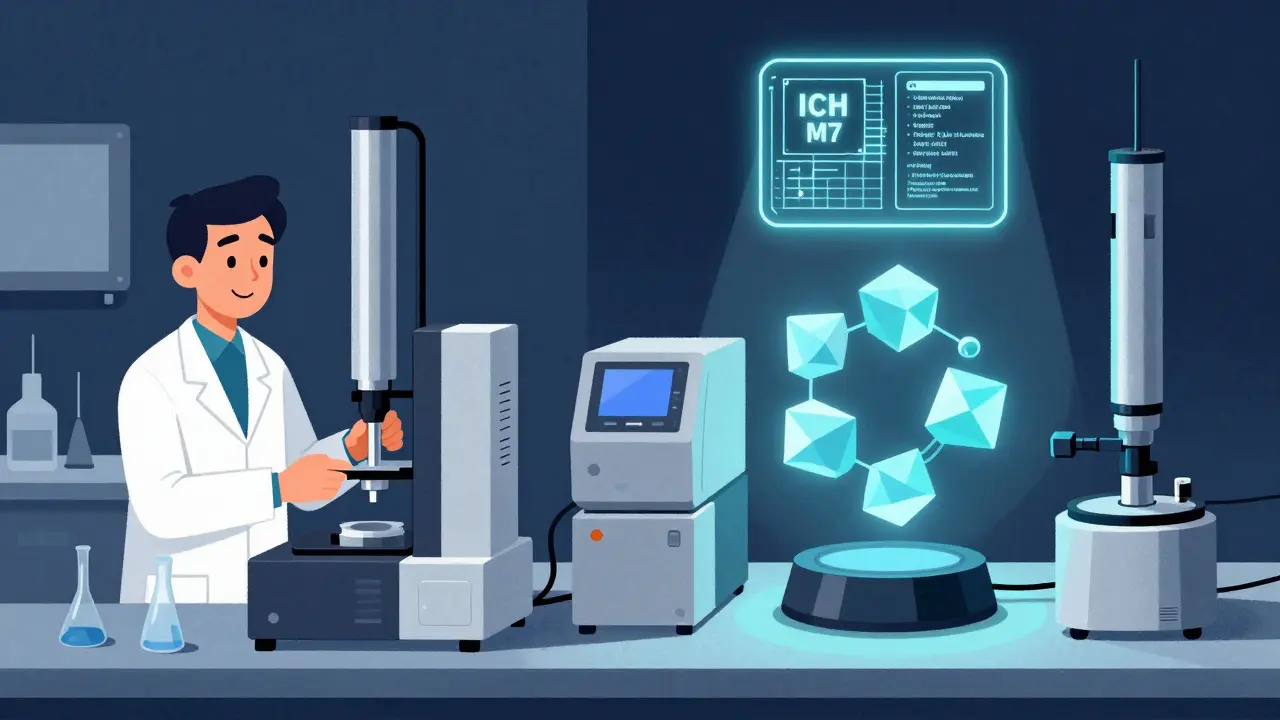
Every drug has impurities. The FDA doesn’t expect perfection. But they do expect you to know what’s in your product-and why it’s safe. This is where ICH M7 guidelines come in. If you have a potential mutagenic impurity, you need a (Q)SAR analysis, genotoxicity studies, or a control strategy that limits it below the threshold.
Many small companies skip this because they assume the reference drug’s impurity profile is enough. It’s not. The FDA requires a full assessment for your specific process. One company submitted an ANDA for a generic asthma inhaler and got a deficiency because their degradation product had a nitrosamine structure. They hadn’t tested for it. The fix? Six months of additional testing and a new manufacturing protocol.
4. Critical Quality Attributes (CQAs) Not Defined (14%)
CQAs are the physical, chemical, biological, or microbiological properties that must be within an appropriate limit to ensure product quality. Think particle size, moisture content, polymorphic form, or dissolution profile. If you don’t clearly define which attributes are critical-and how you control them-you’ll get a deficiency.
Companies often treat CQAs as an afterthought. They list them in a table but don’t link them to manufacturing controls. The FDA wants to see a clear connection: “We control this parameter because it affects this CQA, which impacts safety or efficacy.” Without that logic, the application looks like a checklist, not a science-based submission.
5. Elemental Impurities (13%)
ICH Q3D sets limits for toxic elements like lead, cadmium, arsenic, and mercury in drugs. But many applicants don’t know how to apply it. They test raw materials but ignore the manufacturing process. A stainless-steel reactor might leach nickel. A filter might introduce chromium. The FDA expects a full risk assessment-not just a certificate of analysis.
One survey of 127 generic manufacturers found that 63% said the FDA’s guidance on elemental impurities was too vague for their specific product. That’s not the FDA’s fault. It’s a failure to tailor the guidance to the product. The fix? Conduct a process-specific risk assessment and document every potential source of contamination.
Why Some Companies Keep Failing-And Others Don’t
Not all companies get deficiency letters. And the difference isn’t luck. It’s preparation.
Companies with fewer than 10 approved ANDAs have deficiency rates 22% higher than those with 50+ approvals. Why? Experience. They’ve seen the patterns. They know what the FDA looks for. They’ve learned from past mistakes.
Product complexity matters too. Immediate-release pills? Deficiency rate around 30%. Modified-release tablets? 65%. Peptides? Up to 70%. These aren’t just harder to make-they’re harder to prove are equivalent. The FDA’s review teams for complex products now have specialized training. Their expectations are higher. And they’re catching more.
One major factor? Pre-submission meetings. Companies that request a pre-ANDA meeting with the FDA reduce their deficiency rate by 32%. Why? Because they get direct feedback. They ask, “What do you need to see?” and the FDA tells them. No guessing. No surprises.
How to Avoid a Deficiency Letter
Here’s what works-based on real data from companies that got approved on the first try.
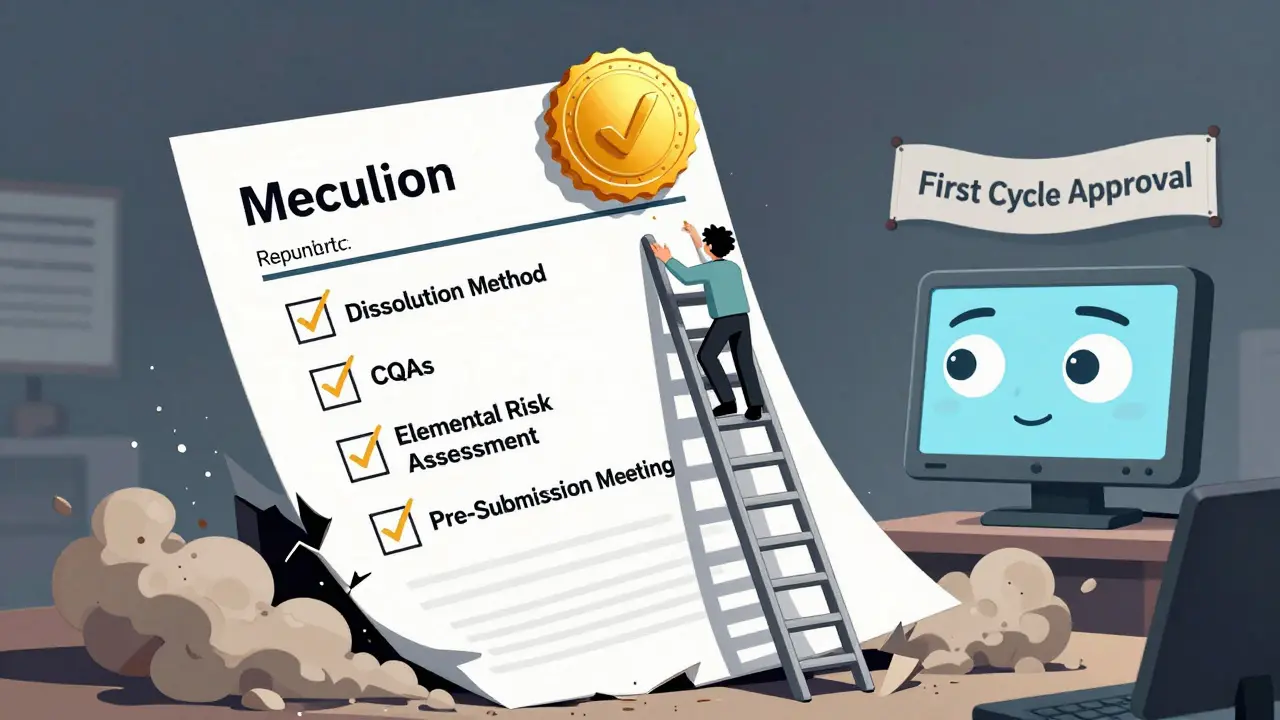
- Use the right dissolution method. Don’t default to Apparatus 2. Test across pH levels. Use biorelevant media if your drug is poorly soluble. The FDA’s May 2021 guidance has examples. Use them.
- Characterize your drug substance fully. For peptides or complex molecules, go beyond HPLC. Add circular dichroism, FTIR, and SEC. Document everything.
- Run a full impurity assessment. Use ICH M7. If there’s any chance of a mutagenic impurity, test for it. Don’t assume it’s safe because the brand-name drug doesn’t have it.
- Define and control your CQAs. Link every critical attribute to a manufacturing step. Show the FDA how you know it’s under control.
- Do a risk assessment for elemental impurities. Map every piece of equipment, filter, and raw material. Document sources and controls. Don’t wait for the FDA to ask.
- Request a pre-submission meeting. Even a 30-minute call can prevent a six-month delay. The FDA wants you to succeed-if you give them the right information.
- Write detailed development reports. Applications with clear explanations of why you chose certain methods have 27% fewer deficiencies. The FDA isn’t just reviewing data-they’re reviewing your thinking.
What’s Changing in 2025 and Beyond
The FDA isn’t standing still. They’re trying to reduce deficiency rates.
In 2023, they launched the First Cycle Generic Drug Approval Initiative. It includes better guidance templates, updated review checklists, and more clarity on what’s expected. In April 2025, they released new template responses for the 10 most common deficiencies. Now, instead of guessing what a fix looks like, you can see an example.
They’ve also created specialized review teams for complex products. That means fewer inconsistent decisions. And by Q3 2026, they plan to roll out AI-assisted pre-submission screening. It will flag common errors before you even submit-like missing (Q)SAR data or wrong apparatus selection.
Industry analysts predict first-cycle approval rates could rise from 52% to 68% by 2027. That’s a big jump. But it won’t happen unless companies start treating the FDA’s expectations as non-negotiable.
Final Reality Check
A deficiency letter isn’t a failure. It’s feedback. But it’s expensive feedback. Each delay costs about $1.2 million in lost time, testing, and legal fees. For a low-revenue generic, that could kill the product. For a high-revenue one, it’s a setback.
The companies that win aren’t the ones with the biggest budgets. They’re the ones who listen. They read the guidance. They test thoroughly. They document clearly. And they don’t assume the FDA will figure it out for them.
If you’re submitting an ANDA, treat the deficiency letter like a checklist-not a threat. Fix the issues. Submit again. And next time, don’t wait for the letter to come. Ask the FDA what they need before you even hit send.
What happens if I ignore a deficiency letter from the FDA?
Ignoring a deficiency letter means your application will not be approved. The FDA will not proceed until all listed issues are addressed and resubmitted. Delays can last 12-24 months, depending on the complexity of the deficiencies. In some cases, the application may be withdrawn or deemed incomplete, forcing you to restart the entire process.
Can I appeal a deficiency letter from the FDA?
You cannot formally appeal a deficiency letter. But you can request a meeting with the FDA to discuss the findings. If you believe the deficiency is based on a misinterpretation, you can provide additional data, scientific literature, or precedent to support your position. Many companies successfully resolve disagreements this way without resubmitting a full application.
How long does it take to respond to a deficiency letter?
There’s no official deadline, but the FDA expects a response within 12 months. Most companies submit their reply within 6-9 months. If you take longer, the application may be considered abandoned. Complex issues-like new toxicology studies or process changes-can take 12-18 months to resolve, so plan accordingly.
Are deficiency letters public information?
Yes. Under the Freedom of Information Act (FOIA), deficiency letters are considered public records once the application is approved or withdrawn. However, proprietary manufacturing details and confidential business information may be redacted. Many companies release summaries of their deficiency letters to inform industry peers.
Do deficiency letters affect the drug’s market exclusivity?
No. Deficiency letters do not extend or shorten market exclusivity periods. Exclusivity is based on the original submission date and any applicable protections (like patent or orphan drug status). But delays caused by deficiencies can push back your launch date, meaning you lose valuable market time-even if your exclusivity period remains unchanged.
Is it better to submit a complete application even if it’s not perfect?
No. Submitting an incomplete or poorly prepared application guarantees a deficiency letter-and often multiple rounds. The FDA prefers a clean, complete submission over a rushed one. A single well-prepared submission with accurate data and clear documentation has a much higher chance of first-cycle approval than multiple submissions with unresolved issues.






Dissolution methods are still the biggest headache in ANDAs, and honestly? Most teams are using Apparatus 2 like it’s 2012. I’ve seen companies waste 18 months because they refused to switch to biorelevant media for a BCS Class II drug. The FDA isn’t being pedantic-they’re trying to prevent another valsartan-level disaster. If your drug doesn’t dissolve the same way in the gut as the brand, it’s not bioequivalent, no matter how clean your HPLC looks.
December 25And don’t even get me started on impurity profiling. ICH M7 isn’t a suggestion. It’s a mandate. I had a client submit an ANDA for a generic inhaler with a nitrosamine they didn’t test for because ‘the brand didn’t have it.’ Six months of rework. $800K gone. The FDA doesn’t care about your assumptions-they care about your data.
Pre-submission meetings? Do them. Even if you think you’re ready. I’ve had regulators tell me things in a 30-minute call that saved us from a year-long delay. They’re not there to block you-they’re there to help you not fail. Stop treating them like enemies and start treating them like partners with a checklist.
And yes, the AI screening tool coming in 2026? It’s gonna be brutal. But if you’re already doing this right, you’ll barely notice it. The ones who panic? The ones still using compendial methods and skipping (Q)SAR? They’re gonna get crushed. The bar’s rising. Adapt or get left behind.
Rachel Cericola