When a blockbuster drug's core patent expires, you might expect generic competitors to flood the market immediately. You'd be wrong. In reality, pharmaceutical companies have built an intricate web of legal protections that keep generics at bay long after the main patent dies. These are called market exclusivity extensions, and they are the hidden engine behind high drug prices.
The original intent was noble: balance the need for innovation with affordable access. But today, these mechanisms often result in monopolies lasting well beyond what lawmakers originally imagined. Understanding how this works is crucial for anyone navigating the complex world of pharmaceutical economics, from investors to patients.
The Foundation: Hatch-Waxman and the Original Balance
To understand where we are, we have to look back at 1984. The Drug Price Competition and Patent Term Restoration Act, commonly known as the Hatch-Waxman Act, created the current framework. Before this, drug developers faced a dilemma: patents took years to secure, but by the time they were granted, much of the 20-year term had already expired during clinical trials. This meant little reward for the risk of developing new medicines.
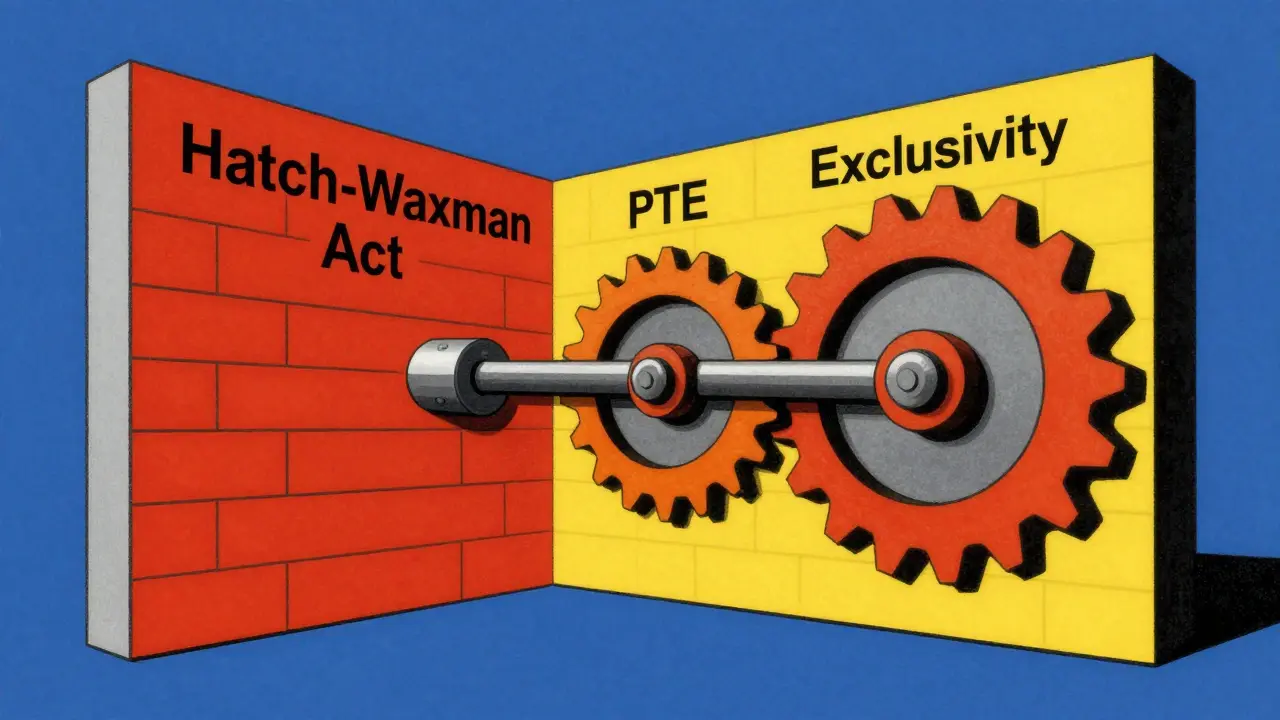
Hatch-Waxman tried to fix this by allowing Patent Term Extensions (PTEs). The goal was simple: compensate for the time lost waiting for FDA approval. The law anticipated that drugs would enjoy about nine years of market protection after approval, with PTEs adding up to five more years. This capped the total post-approval monopoly at 14 years. It was supposed to be a fair trade-off.
However, the landscape has shifted dramatically. A 2023 study in the Yale Law and Policy Review found that 91% of drugs receiving patent term extensions continue their monopolies far beyond those limits. How? By stacking secondary patents and regulatory exclusivities on top of the core patent. One documented case involved a single drug accumulating 48 additional patents. This isn't just legal technicality; it's a strategic business model.
Regulatory Exclusivity vs. Patent Protection
It is vital to distinguish between patents and regulatory exclusivity. They are separate tools with different rules. A patent protects the invention itself-the chemical structure or process. Regulatory exclusivity, granted by agencies like the FDA or EMA, prevents competitors from marketing similar products based on the original company's safety and efficacy data.
Think of it this way: a patent says "you can't make this." Regulatory exclusivity says "you can't sell this using my data," even if you could theoretically make it yourself. Crucially, regulatory exclusivity can extend protection beyond the patent term or exist entirely without patent protection. This independence makes it a powerful tool for companies, especially for orphan drugs where patents might not cover all variations.
- Patent Term Extension (PTE): Compensates for regulatory delays. Capped at 5 years, with a maximum of 14 years post-approval.
- New Chemical Entity (NCE) Exclusivity: Grants 5 years of protection for a drug with a new active ingredient. Prevents generic applications during this period.
- Orphan Drug Exclusivity: Offers 7 years in the US for drugs treating rare diseases (fewer than 200,000 patients).
- Pediatric Exclusivity: Adds 6 months to existing exclusivities if the company completes agreed-upon pediatric studies.
US vs. EU: Different Rules, Same Goal
If you operate globally, you face two distinct systems. The United States and the European Union use different mechanisms to achieve similar outcomes, but the nuances matter significantly for strategy.
| Mechanism | United States (FDA) | European Union (EMA) |
|---|---|---|
| Primary Extension Tool | Patent Term Extension (PTE) | Supplemental Protection Certificate (SPC) |
| Max Post-Approval Protection | 14 years | 15 years (plus potential additions) |
| Orphan Drug Exclusivity | 7 years | 10 years (12 with pediatric compliance) |
| New Indication Protection | 3 years (requires new formulation/strength) | 1 year extension to SPC (if significant benefit proven) |
| Data Exclusivity | 5 years (NCE), 3 years (new clinical investigation) | 8+2+1 years structure |
The EU's Supplemental Protection Certificate (SPC) system allows for up to 15 years of marketing protection beyond the standard 20-year patent term. This is slightly longer than the US cap. Additionally, the EU offers the Pediatric-Use Marketing Authorization (PUMA), which provides eight plus two years of data and market protection for pediatric-specific medicines, even if no patent exists. This is a critical incentive for developing treatments for children.
In contrast, the US system excels at "stacking." Companies can layer multiple exclusivities. For example, a company might secure NCE exclusivity, then add six months of pediatric exclusivity, while simultaneously filing secondary patents for new formulations. This flexibility allows US-based firms to tailor their protection strategies precisely to their product lifecycle.
The Art of Stacking: Extending Monopolies
How do companies actually extend their monopolies? It requires sophisticated regulatory strategy. The learning curve is steep, typically taking 3-5 years of specialized experience. Major pharmaceutical companies dedicate teams of 15-25 specialists solely to managing these exclusivities for blockbuster drugs.
The process begins late in clinical development. Companies must decide whether to pursue new indication exclusivity, which requires proving clinical superiority for a new use, or pediatric exclusivity, which involves completing specific studies within tight timelines. The stakes are enormous. As one senior patent attorney noted on Reddit, getting that extra six months of pediatric extension can be worth billions.
A common tactic is the "patent thicket" strategy. Instead of relying on one core patent, companies file dozens of secondary patents covering minor modifications: new dosing strengths, improved administration methods, or expanded uses. Tazarotene, for instance, accumulated 48 additional patents beyond its core compound patent. This creates a legal maze that generic manufacturers must navigate, delaying entry and increasing costs.
Another controversial practice is "product hopping." Just before a core patent expires, a company introduces a slightly modified version of the drug-perhaps a new delivery mechanism or formulation-and encourages doctors to switch patients to it. When the old patent expires, generics enter for the old version, but most patients are now on the new, protected version. Teva Pharmaceuticals reported that such tactics delayed generic entry for 17% of their target molecules.
Economic Impact and Criticism
The economic impact of these extensions is staggering. The US pharmaceutical market generated $621 billion in 2022, with branded drugs accounting for 78% of revenue despite representing only 10% of prescriptions. Market exclusivity extensions directly fuel this concentration.
A JAMA Health Forum study calculated that extended market exclusivity for just four top-selling drugs resulted in $3.5 billion in additional spending over a two-year period following generic competition. Without these extensions, net spending would have dropped significantly. For industry leaders, this is essential. The Biotechnology Innovation Organization (BIO) found that 68% of biotech startups consider market exclusivity extensions critical for securing venture capital funding. Developing a new drug costs an average of $2.3 billion; without guaranteed periods of monopoly pricing, many innovations simply wouldn't happen.
However, critics argue the system is broken. Dr. Aaron Kesselheim of Harvard Medical School notes that "the end of monopoly time rarely comes at the expiration of a core patent." Instead, it comes after layers of secondary protections have worn off. Healthcare policy experts warn that "evergreening" practices now delay generic competition for an average of 9.2 years beyond core patent expiration, up from 3.1 years in 2000. This tension between incentivizing innovation and ensuring affordable access is driving increased regulatory scrutiny.
Future Trends and Regulatory Scrutiny
The landscape is changing. Regulators are tightening the screws. In April 2023, the FDA finalized guidance requiring more substantial evidence of clinical benefit for three-year new indication exclusivity. Previously, minor changes might have qualified; now, the bar is higher. The Federal Trade Commission has also filed briefs arguing that product hopping violates antitrust laws, potentially limiting this aggressive tactic.
In Europe, the European Commission proposed revisions to the SPC system in June 2023 to better incentivize true innovation rather than minor modifications. The goal is to prevent companies from gaming the system with trivial updates. Meanwhile, the European Medicines Agency launched a pilot program to accelerate review of pediatric investigation plans, aiming to boost uptake of the 6-month SPC extension for children's medicines.
Despite these changes, industry analysts predict continued growth in exclusivity periods. Evaluate Pharma forecasts that by 2028, the average effective market exclusivity period for new drugs will reach 16.3 years, up from 12.7 years in 2018. Orphan drug designations have surged, growing from 201 in 2010 to 1,027 in 2022, representing 38% of new approvals. This pathway remains highly attractive for targeting niche markets with unmet needs.
What is the difference between a patent and market exclusivity?
A patent protects the intellectual property of an invention, preventing others from making, using, or selling the patented technology. Market exclusivity is a regulatory privilege granted by health authorities like the FDA or EMA. It prevents competitors from marketing similar products based on the original company's safety and efficacy data, even if no patent exists or has expired. Exclusivity can extend protection beyond patent terms.
How long does orphan drug exclusivity last in the US?
In the United States, orphan drug exclusivity lasts for 7 years. This applies to drugs designed to treat rare diseases affecting fewer than 200,000 Americans. During this period, the FDA cannot approve another application for the same drug and indication, unless the competitor proves clinical superiority. In the EU, this period is 10 years, extendable to 12 years if pediatric data requirements are met.
What is "product hopping" in pharmaceuticals?
Product hopping is a strategy where a brand-name drug manufacturer introduces a slightly modified version of a drug (e.g., new formulation, dosage, or delivery method) just before the core patent expires. They then encourage physicians and patients to switch to the new version. When the old patent expires, generics enter for the old version, but most patients remain on the new, still-protected version, effectively maintaining the monopoly.
Can a drug have market exclusivity without a patent?
Yes. Regulatory exclusivity is independent of patent protection. For example, New Chemical Entity (NCE) exclusivity grants 5 years of protection regardless of patent status. Similarly, the EU's Pediatric-Use Marketing Authorization (PUMA) provides data and market protection for pediatric medicines even if no patent covers them. This is particularly important for orphan drugs where patent coverage might be limited or non-existent.
Why do companies use "patent thickets"?
Companies use patent thickets to create a dense network of overlapping patents around a single drug. By filing numerous secondary patents for minor modifications (like new dosing strengths or administration methods), they create legal hurdles for generic manufacturers. To launch a generic, competitors must challenge each patent, which is costly and time-consuming. This strategy delays generic entry and extends the effective monopoly period well beyond the core patent expiration.







I read through this and honestly just feel tired by the whole situation. It makes sense why pharma companies do it from a business perspective, but it sucks for everyone else trying to afford meds. The EU having slightly different rules is interesting though, maybe we can learn something from their approach to pediatric incentives?
June 12Daniella Renzon