Imagine standing in a hospital room, holding a paper that says your arteries are blocked. The doctor looks at you and asks a question that feels like it carries the weight of your future: "Do you want a stent or do you want surgery?" It’s one of the most stressful moments in modern medicine. You’re not just choosing a procedure; you’re choosing how much of your life you’ll spend recovering versus how long that fix will last.
This isn’t a decision to take lightly. Coronary revascularization is the medical process of restoring blood flow to the heart muscle by opening blocked arteries, and it comes in two main flavors: Percutaneous Coronary Intervention (PCI) and Coronary Artery Bypass Grafting (CABG). One is a quick catheter job; the other is major open-heart surgery. Getting this choice wrong can mean unnecessary suffering or, worse, a higher risk of death down the line. Let’s break down exactly what these procedures are, who they help, and how you can talk to your doctors to make the right call.
The Two Paths to a Clearer Heart
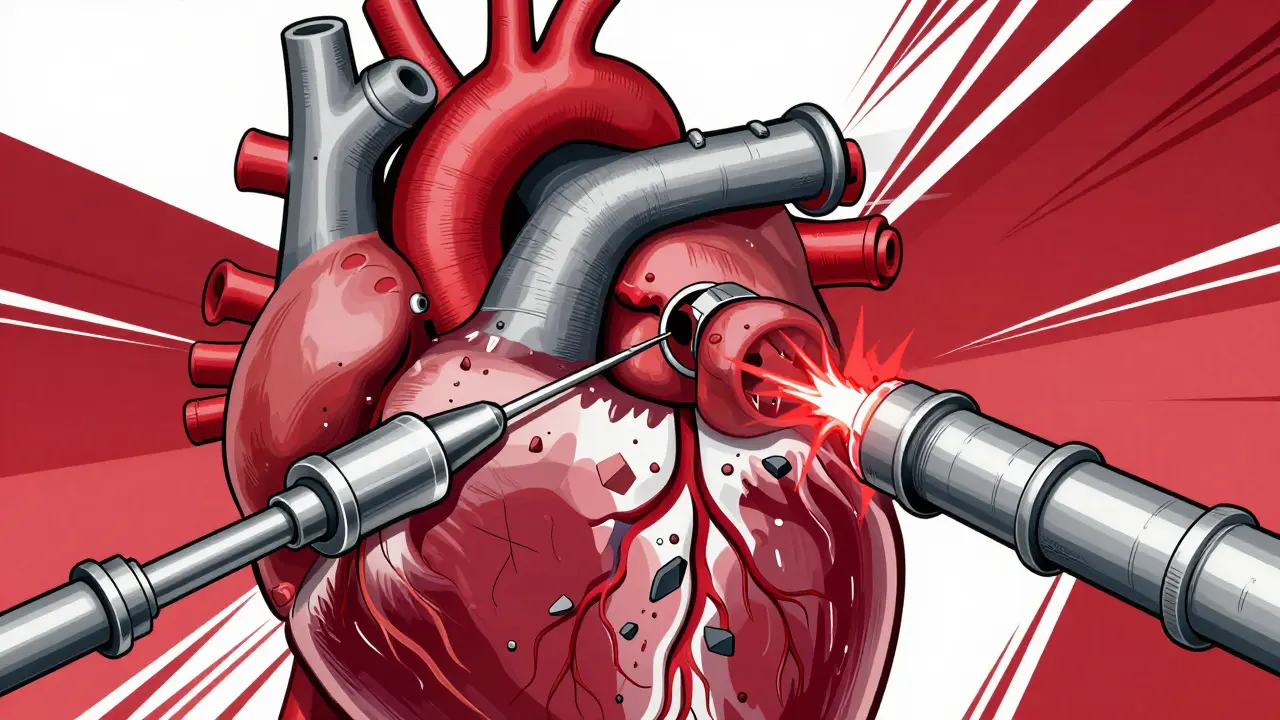
To understand the difference, you have to look at the mechanics. Think of your coronary arteries like garden hoses clogged with dirt. You have two ways to fix them. You can either send a high-pressure jet through the hose to blast the dirt out and hold the walls open (that’s PCI), or you can cut a new pipe around the clog entirely so water flows freely again (that’s CABG).
Percutaneous Coronary Intervention, commonly known as angioplasty with stenting, is minimally invasive. A cardiologist threads a thin tube called a catheter up through an artery in your wrist (radial) or groin (femoral) and guides it to your heart. Once there, they inflate a tiny balloon to push the plaque against the artery wall and insert a mesh tube called a stent to keep it open. Most patients go home within 24 hours. In the US alone, about 600,000 of these procedures happen every year because they are fast and less traumatic.
Coronary Artery Bypass Grafting, or bypass surgery, is different. A cardiac surgeon opens your chest, takes a healthy blood vessel from another part of your body part-usually the internal mammary artery in your chest or a vein from your leg-and sews it onto your coronary artery above and below the blockage. This creates a detour. It’s bigger surgery. It requires a sternotomy (cutting through the breastbone), often uses a heart-lung machine to keep you alive while the heart stops beating, and demands a hospital stay of five to seven days. About 300,000 bypasses are performed annually in the US.
| Feature | PCI (Stents) | CABG (Bypass) |
|---|---|---|
| Invasiveness | Minimally invasive (catheter-based) | Majors surgery (open chest) |
| Hospital Stay | 1-2 days | 5-7 days |
| Recovery Time | Days to weeks | 6-8 weeks |
| Anesthesia | Local + Sedation | General Anesthesia |
| Repeat Procedures | Higher risk (5-10% at 5 years) | Lower risk (long-lasting grafts) |
Who Wins on Survival and Long-Term Health?
If recovery speed were the only metric, PCI would win every time. But heart disease is a marathon, not a sprint. When we look at who lives longer and has fewer heart attacks over five or ten years, the data gets specific. And here is where your anatomy matters more than your preference.
The biggest factor is something called the SYNTAX score. Doctors calculate this by looking at your angiogram (the X-ray video of your arteries) and counting how many blocks you have, how complex they are, and where they are located. A low score means simple blockages. A high score means messy, widespread disease.
For people with simple blockages (SYNTAX score under 22), PCI is usually just as good as bypass surgery, but with way less hassle. However, when the disease gets complex (SYNTAX score over 32), bypass surgery pulls ahead significantly. A massive meta-analysis combining data from 11 trials involving over 11,000 patients showed that CABG offered a 2% absolute survival advantage over PCI at five years. More importantly, patients who had bypasses were half as likely to need another procedure to fix their heart.
Diabetes changes the equation completely. If you have diabetes and multivessel disease, the FREEDOM trial-a landmark study published in the New England Journal of Medicine-showed that bypass surgery drastically reduced the risk of death compared to stents. Five-year mortality was 16.4% for stent patients versus 10.0% for bypass patients. That’s a huge gap. For diabetic patients, especially those with involvement of the left anterior descending (LAD) artery-the big artery on the front of the heart-bypass is strongly recommended.
The Left Main Dilemma
There is one specific spot in the heart that causes headaches for doctors: the left main coronary artery. This single vessel supplies blood to about two-thirds of the heart muscle. If it gets blocked, it’s catastrophic.
Historically, bypass was the gold standard for left main disease. But newer stents have changed the conversation. The EXCEL trial, which followed patients for five years, showed that for certain patients with left main disease, PCI was non-inferior to CABG in terms of major adverse events. However, there was a twist: PCI patients had lower risks in the first month, but CABG patients pulled ahead after year one. By year five, the bypass group had better outcomes regarding repeat procedures and heart attacks.
So, if you have left main disease, the choice depends on your SYNTAX score and your overall health. If your anatomy is simple, a stent might be fine. If it’s complex, bypass is still the safer bet for long-term durability.

Quality of Life: The Hidden Cost of Surgery
Statistics tell you who survives, but they don’t tell you how you feel. This is where patient experience shines a light on the trade-offs.
In the short term, PCI wins hands down. Data from the VA CART registry shows that 87% of PCI patients return to work within two weeks. Compare that to only 32% of CABG patients. Why? Because cutting through your breastbone hurts. About 45% of bypass patients report significant sternal pain three months after surgery. While this drops to 12% by year one, it’s a real hurdle. Plus, some patients experience cognitive fog or memory issues after being on the heart-lung machine, affecting about 18% at six weeks.
But flip the clock forward one year, and the story shifts. The ROSETTA trial found that bypass patients reported better quality-of-life scores related to angina (chest pain) than stent patients. Why? Because stents can fail. Plaque can grow back inside the stent (restenosis), or new blockages can form elsewhere. About 15-20% of PCI patients end up needing another procedure. Bypass grafts, particularly the arterial ones taken from the chest, have a patency rate (staying open) of 85-90% at ten years. Vein grafts aren’t as durable (60-70%), but they still generally outlast stents in complex cases.
As one patient shared online: "Back to work in 3 days with the stent, but I needed another one 18 months later." Another said: "Six weeks of recovery was tough, but two years later I’m hiking with zero chest pain." Both experiences are valid. It depends on whether you value immediate freedom or long-term certainty.
The Heart Team Approach: Your Best Defense
You should never have to choose between a cardiologist and a surgeon based on who sees you first. Current guidelines from the American College of Cardiology (ACC) and the American Heart Association (AHA) mandate a "Heart Team" approach. This means both an interventional cardiologist (who does stents) and a cardiac surgeon (who does bypasses) sit down together to review your case.
Why is this crucial? Because specialists have biases. Cardiologists tend to favor stents; surgeons favor bypasses. A Heart Team discussion neutralizes this. They look at your SYNTAX score, your kidney function, your lung health, and your personal preferences. Studies show that hospitals with formal Heart Team protocols have better outcomes and fewer unnecessary surgeries.
If your doctor doesn’t mention a Heart Team consultation, ask for one. Especially if you have diabetes, multiple blockages, or left main disease. It’s your right to have both perspectives before signing consent forms.

Practical Considerations: Insurance and Recovery
Let’s talk about the unglamorous stuff: money and logistics. Bypass surgery costs more upfront. Medicare reimburses roughly $35,000 for a CABG versus $12,500 for a PCI. However, insurance companies sometimes fight harder to approve bypasses because they require prior authorization, viewing them as elective unless symptoms are severe. Stents are often approved faster because they are seen as urgent fixes for acute symptoms.
Recovery logistics also differ. With PCI, you might need someone to drive you home that day, but you’re largely on your own the next morning. With CABG, you need help for weeks. You can’t lift anything heavier than a gallon of milk for six to eight weeks while your sternum heals. If you live alone or work a physical job, this timeline needs serious planning.
Future Trends: Hybrid Approaches
Medicine rarely stays static. We are seeing the rise of "hybrid" procedures. Imagine having a minimally invasive robotic bypass done on your left anterior descending artery (the most critical one) combined with stents for the other vessels. This approach aims to get the durability of the arterial graft for the main artery while avoiding the trauma of full open-heart surgery. While still emerging, early data suggests this could be the sweet spot for many patients in the coming decade.
Also, watch for improvements in complete revascularization. The COMPLETE trial showed that fixing *all* significant blockages, rather than just the one causing a heart attack, reduces future cardiac events by 25%. Whether via stents or bypass, leaving bad arteries alone is no longer the strategy.
Is PCI or CABG better for longevity?
For patients with simple blockages, both offer similar longevity. However, for patients with complex multi-vessel disease, diabetes, or left main disease, CABG (bypass surgery) has been proven to offer a survival advantage and lower rates of repeat procedures over the long term (5+ years).
How long does it take to recover from bypass surgery?
Hospital stay typically lasts 5-7 days. Full recovery, including healing of the sternum, takes 6-8 weeks. Most patients can return to desk jobs within 4-6 weeks, but heavy lifting is restricted for 2-3 months.
What is the SYNTAX score?
The SYNTAX score is a numerical value calculated from your coronary angiogram that measures the complexity of your coronary artery disease. Scores under 22 favor PCI (stents), while scores over 32 favor CABG (bypass). Intermediate scores require careful Heart Team evaluation.
Can I choose which procedure I want?
You can express your preferences, but the medical indication must align. Guidelines recommend a Heart Team approach where both cardiologists and surgeons agree on the best option based on your anatomy and health risks. Choosing against medical advice can lead to worse outcomes.
Are drug-eluting stents safe?
Yes, modern drug-eluting stents are highly effective and safe. They release medication to prevent scar tissue growth, reducing restenosis rates to 5-10% at 5 years. Patients must take dual antiplatelet therapy (blood thinners) for a specified period to prevent clots forming on the stent.