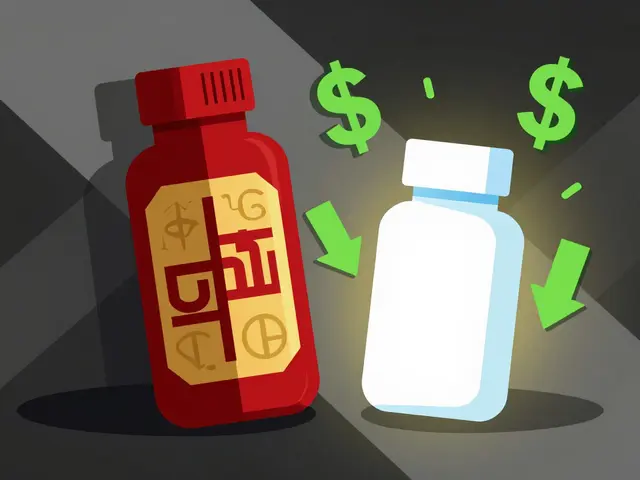
The era of simple copycat drugs is ending. For decades, the generic pharmaceutical industry operated on a straightforward model: wait for a patent to expire, replicate the molecule, and sell it at a fraction of the cost. But that model is collapsing under the weight of price erosion. Today, the real battleground isn't just about making cheaper pills; it's about creating generic combinations-often called "super generics"-that offer better delivery, improved safety, or added convenience.
We are standing at a pivotal moment in 2026. The global market for these advanced generic products is projected to skyrocket from USD 235.6 billion in 2025 to nearly USD 475 billion by 2035. This isn't just incremental growth; it represents a fundamental shift in how we think about affordable healthcare. If you're navigating this space, whether as an investor, a regulator, or a patient advocate, understanding the regulatory maze and the economic drivers behind these complex products is no longer optional-it's essential.
What Exactly Are Generic Combinations?
To understand where the industry is going, we first need to define what we're talking about. A traditional generic is a bioequivalent copy of a branded drug. It has the same active ingredient, strength, dosage form, and route of administration. A generic combination is a pharmaceutical product that merges multiple active ingredients, innovative delivery systems, or device-drug integrations into a single therapeutic solution.
These products fall into three main buckets:
- Fixed-Dose Combinations (FDCs): Two or more active pharmaceutical ingredients merged into one pill. Think of combining an ACE inhibitor with a diuretic for hypertension. The goal is compliance-one pill instead of two.
- Drug-Device Combinations: Products like inhalers, auto-injectors, or transdermal patches where the device is critical to the drug's performance. These face the most complex regulatory scrutiny because the device and drug must work in perfect harmony.
- Modified-Release Formulations: Extended-release, delayed-release, or targeted-release versions that change how the body absorbs the drug over time. These require sophisticated pharmacokinetic modeling to prove they behave like the reference product.
The key differentiator here is value. Unlike traditional generics that compete solely on price, generic combinations compete on therapeutic advantage. They address specific clinical needs-like reducing side effects or improving adherence-that standard generics cannot touch.
The Regulatory Gauntlet: Why Approval Is Harder Than Ever
If you think getting approval for a simple generic is tough, try doing it for a combination product. The regulatory landscape is the single biggest barrier-and opportunity-in this sector.
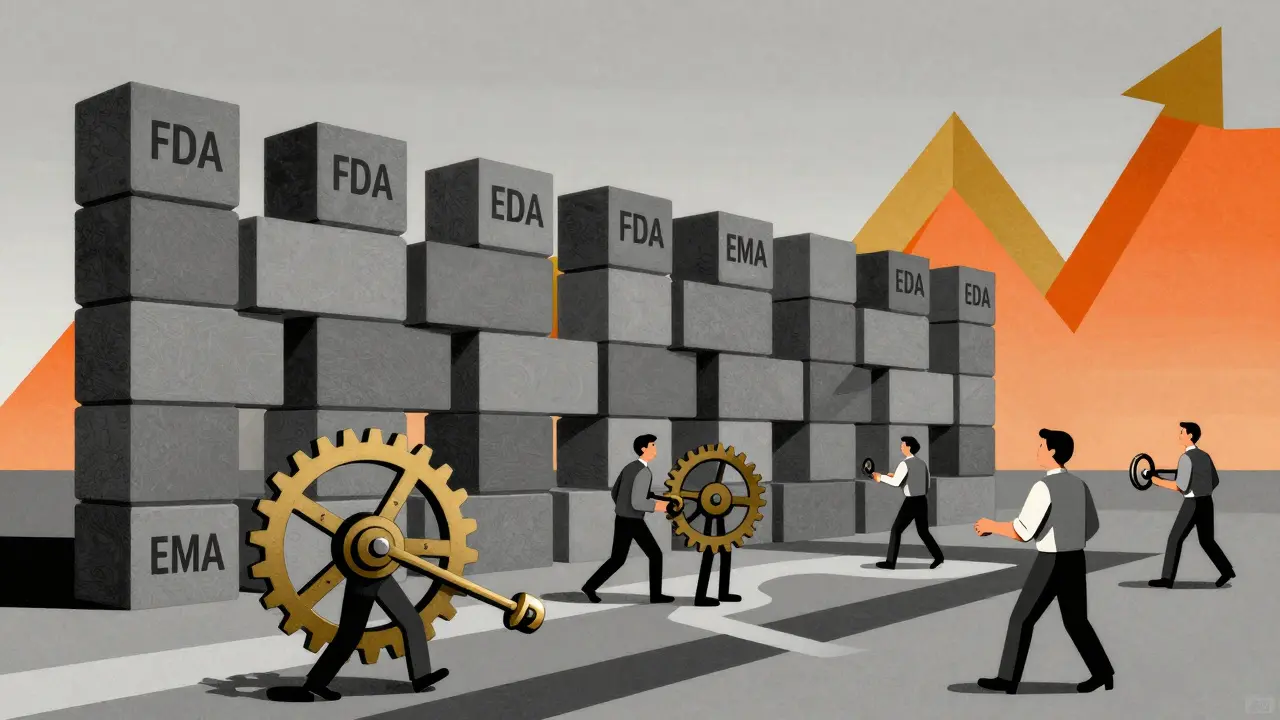
In the United States, the FDA is the primary regulatory body overseeing drug approvals through pathways like the Abbreviated New Drug Application (ANDA) handles most generics. However, generic combinations often slip through the cracks of standard ANDA pathways. For FDCs, manufacturers must demonstrate a clear therapeutic advantage over taking the components separately. For drug-device combos, the FDA’s Office of Combination Products determines the primary mode of action, which can trigger dual review processes involving both drug and device divisions.
The data tells a stark story. According to internal FDA metrics from 2024, generic combinations require 30-50% more clinical data than traditional generics. Approval timelines stretch out by 18-24 months on average. In October 2025, the FDA launched a pilot program to speed up reviews for US-manufactured generics, but this only applies to a small subset of products. Meanwhile, the European Medicines Agency (EMA) remains far more conservative. As of Q1 2025, the EU had approved only 12 complex generic combinations compared to 37 in the US. This regulatory divergence creates a fragmented market where companies must tailor strategies regionally.
Dr. Aaron Kesselheim of Harvard Medical School warned in a 2025 NEJM article that the definition of "therapeutic equivalence" for complex generics remains inadequately defined. This ambiguity creates potential safety gaps. When 78% of generic combination failures stem from inadequate demonstration of equivalence in complex delivery systems rather than the active ingredient itself, the stakes are incredibly high.
The Economics: High Risk, Higher Reward
Why would any company endure this regulatory pain? The answer lies in the economics. Traditional generics are a race to the bottom. Once multiple manufacturers enter the market, prices drop 80-90% within two years. Margins shrink to less than 5%. It’s a volume game that favors massive scale.
Generic combinations tell a different story. IQVIA’s 2025 analysis shows that these products maintain 40-60% price retention over five years. Why? Because they offer differentiation. You’re not just selling a cheaper version of Drug X; you’re selling a better experience. Look at Teva’s Budeprion XL, an extended-release bupropion. Before generic competition hit, it generated $187 million in annual sales. Compare that to traditional bupropion generics, which combined for only $42 million. The premium is real.
However, the entry ticket is expensive. Developing a traditional generic costs $1-5 million with a 2-3 year timeline. Complex generic combinations require $15-50 million per product and take 4-7 years to develop, according to Aspen Pharmacare’s 2025 financial disclosures. This makes them unsuitable for low-volume therapeutic areas but highly advantageous in niches with high unmet need and limited competition, such as complex respiratory conditions where only 3-4 manufacturers typically compete.
Market Drivers: The Patent Cliff and Therapeutic Shifts
Several powerful forces are accelerating the adoption of generic combinations. First, there’s the unprecedented wave of patent expirations. Between 2025 and 2030, branded drugs generating $217-$236 billion in annual sales will lose exclusivity. This isn’t just any drugs; these are high-value targets.
Consider Trelegy Ellipta, a respiratory combination with $2.8 billion in US sales in 2024. Or Austedo, a complex CNS combination for movement disorders with $1.2 billion in sales. As these patents expire, the opportunity for sophisticated generic versions explodes. Oncology combinations are growing fastest at 11.3% CAGR, driven by kinase inhibitor combinations. Respiratory follows at 9.89%, fueled by inhalable generics. CNS rounds out the top three at 8.7%.
Regionally, the US dominates with 42% market share due to favorable reimbursement policies. India is emerging as the manufacturing hub, holding 35% of global production capacity for complex generics. But the real story is the shift in spending power. Generics now account for 90% of US prescriptions but less than 20% of total spending. There is immense pressure to develop higher-value combinations that capture a greater revenue share.
| Attribute | Traditional Generics | Generic Combinations (Super Generics) |
|---|---|---|
| Development Cost | $1-5 million | $15-50 million |
| Time to Approval | 2-3 years | 4-7 years |
| Price Erosion (2 Years) | 80-90% | 40-60% retention over 5 years |
| Market Share Potential | High volume, low margin (<5%) | Specialized niche, high margin (20-35%) |
| Regulatory Complexity | Standard ANDA pathway | Complex pathways, additional clinical data |

Strategic Consolidation and Future Trends
The competitive landscape is reshaping rapidly. We’re seeing major consolidation as companies realize that scale matters more than ever when developing complex products. Sandoz separated from Novartis to become a pure-play generics company focused on complex products. Viatris and Credence completed a $2.3 billion merger in Q2 2025 specifically to bolster their complex generics capabilities.
Three dominant trends are emerging for the next decade:
- Increasing Complexity Premium: Products with multiple innovations-like a new delivery system plus a novel combination-are commanding 2-3x traditional generic pricing. Companies are racing to add layers of sophistication.
- Regional Regulatory Divergence: The US is adopting more flexible approaches to complex combinations, while the EU remains cautious. This will create distinct market strategies for multinational players.
- Strategic Partnerships: Device manufacturers and generic pharma companies are joining forces. Catalent’s partnership with Hikma on auto-injectors is a prime example. No single company has all the expertise needed for drug-device combos anymore.
Looking ahead, the focus is shifting toward blockbuster targets. Aspen Pharmacare is actively developing generic semaglutide combinations targeting the $100+ billion GLP-1 market. Fixed-dose versions combining semaglutide with other diabetes medications are in the pipeline. This signals that even the hottest new drug classes won’t escape the super generic revolution.
Navigating the Risks
Despite the optimism, risks remain significant. Morningstar warns of intensifying pricing pressure that could erode margins for all generics by 30% over the next decade if companies fail to transition to higher-value combinations. Additionally, the lack of harmonized global standards creates inefficiencies. ICH Q14 guidelines, finalized in June 2025, aim to standardize analytical procedure development, but implementation will take time.
For investors and stakeholders, the key takeaway is this: generic combinations are not just an evolutionary step; they are a strategic necessity. Companies that cling to the old model of simple replication will find themselves squeezed out. Those that embrace complexity, navigate the regulatory hurdles, and deliver genuine therapeutic value will capture the lion's share of the future generics market.
What is the difference between a traditional generic and a generic combination?
A traditional generic is a bioequivalent copy of a single branded drug with the same active ingredient and dosage form. A generic combination, or "super generic," merges multiple active ingredients, uses innovative delivery systems, or integrates devices to offer therapeutic advantages like improved efficacy, safety, or patient compliance beyond what a simple copy provides.
Why are generic combinations more expensive to develop?
Generic combinations require significantly more clinical data, specialized manufacturing equipment, and complex regulatory submissions. While traditional generics cost $1-5 million to develop, complex combinations can cost $15-50 million due to the need for bioequivalence studies in modified-release profiles, drug-device integration testing, and demonstrating therapeutic advantage over individual components.
How do regulatory pathways differ for drug-device combinations?
Drug-device combinations face the most complex regulatory pathway. Under 21 CFR Part 4 subpart D, the FDA's Office of Combination Products determines the primary mode of action. This often triggers dual review processes involving both drug and device divisions, requiring extensive testing to ensure the device and drug work together safely and effectively, unlike standard ANDA pathways for simple generics.
Which therapeutic areas are driving growth in generic combinations?
Oncology is growing fastest at 11.3% CAGR, driven by kinase inhibitor combinations. Respiratory follows at 9.89% CAGR due to inhalable generics, and Central Nervous System (CNS) disorders grow at 8.7% CAGR. These areas benefit from high unmet medical needs and limited competition compared to saturated markets like statins.
What is the projected market size for super generics by 2035?
According to Future Market Insights, the super generics market segment is projected to grow from USD 235.6 billion in 2025 to USD 474.6 billion by 2035, reflecting a compound annual growth rate (CAGR) of 7.2%. This growth is driven by patent expirations of high-value branded drugs and the demand for enhanced formulations.