
Imagine waking up every morning feeling like you’re wading through mud. Your hair is thinning, your clothes feel tighter despite eating less, and no amount of coffee seems to spark any energy. If this sounds familiar, you might be dealing with Hashimoto’s thyroiditis, a condition where your immune system mistakenly attacks your own thyroid gland. It is the leading cause of hypothyroidism in iodine-sufficient regions, accounting for roughly 90% of cases in places like the United States. Understanding how to manage this chronic autoimmune disorder isn’t just about taking a pill; it’s about mastering the art of TSH monitoring to keep your body in balance.
What Is Hashimoto’s Thyroiditis?
Hashimoto’s thyroiditis is an autoimmune disease first described by Japanese physician Hakaru Hashimoto in 1912. In simple terms, your immune system confuses your thyroid tissue for a threat and sends antibodies to attack it. Over time, this inflammation damages the thyroid, reducing its ability to produce essential hormones-specifically thyroxine (T4) and triiodothyronine (T3). Without these hormones, your metabolism slows down, affecting everything from your heart rate to your digestion.
The condition affects about 4% of the adult US population, but it hits women much harder than men. Women are five to ten times more likely to develop Hashimoto’s, often showing symptoms between ages 30 and 50. While genetics play a role, environmental triggers like stress, viral infections, or even certain medications can spark the onset. The key takeaway? It’s not your fault, but managing it requires active participation.
Diagnosing the Condition: Beyond Just Feeling Tired
Feeling tired is vague. Diagnosing Hashimoto’s relies on specific blood tests that look at both function and autoimmunity. The standard diagnostic protocol starts with measuring your Thyroid-Stimulating Hormone (TSH). TSH is produced by your pituitary gland to tell your thyroid to work harder. When your thyroid is failing, your pituitary screams louder, raising TSH levels.
- TSH Level: A level above 4.5 mIU/L usually triggers further investigation.
- Free T4 (FT4): This measures the actual hormone available in your blood. Low FT4 with high TSH confirms primary hypothyroidism.
- Thyroid Peroxidase Antibodies (TPOAb): Levels typically above 35 IU/mL confirm the autoimmune nature of the disease.
If your TSH is high and your TPOAb is elevated, you have Hashimoto’s. Interestingly, once diagnosed, you don’t need to keep checking antibody levels. As the American Thyroid Association notes, repeating antibody tests doesn’t change treatment plans. The focus shifts entirely to functional markers-mainly TSH.
The Gold Standard: TSH Monitoring Protocols
Once diagnosis is confirmed, the goal is achieving "euthyroidism"-a state where your thyroid hormone levels are normal and you feel well. The primary tool for this is TSH monitoring. But when do you test, and what numbers matter?
Major medical organizations, including the American Association of Clinical Endocrinologists (AACE) and the American Academy of Family Physicians (AAFP), agree on a general target range for most adults under 65: 0.4 to 4.0 mIU/L. However, "normal" isn’t one-size-fits-all. For older adults (65+), slightly higher TSH levels (up to 6.0 mIU/L) may be appropriate. Conversely, some patients feel best when their TSH is in the lower half of the range, around 0.4 to 2.5 mIU/L.
| Age Group | Target TSH Range (mIU/L) | Notes |
|---|---|---|
| Under 65 years | 0.4 - 4.0 | Standard adult range per AACE guidelines |
| 65 years and older | 4.0 - 6.0 | Slightly higher tolerance recommended |
| Pregnant (First Trimester) | 0.1 - 2.5 | Strict control needed for fetal development |
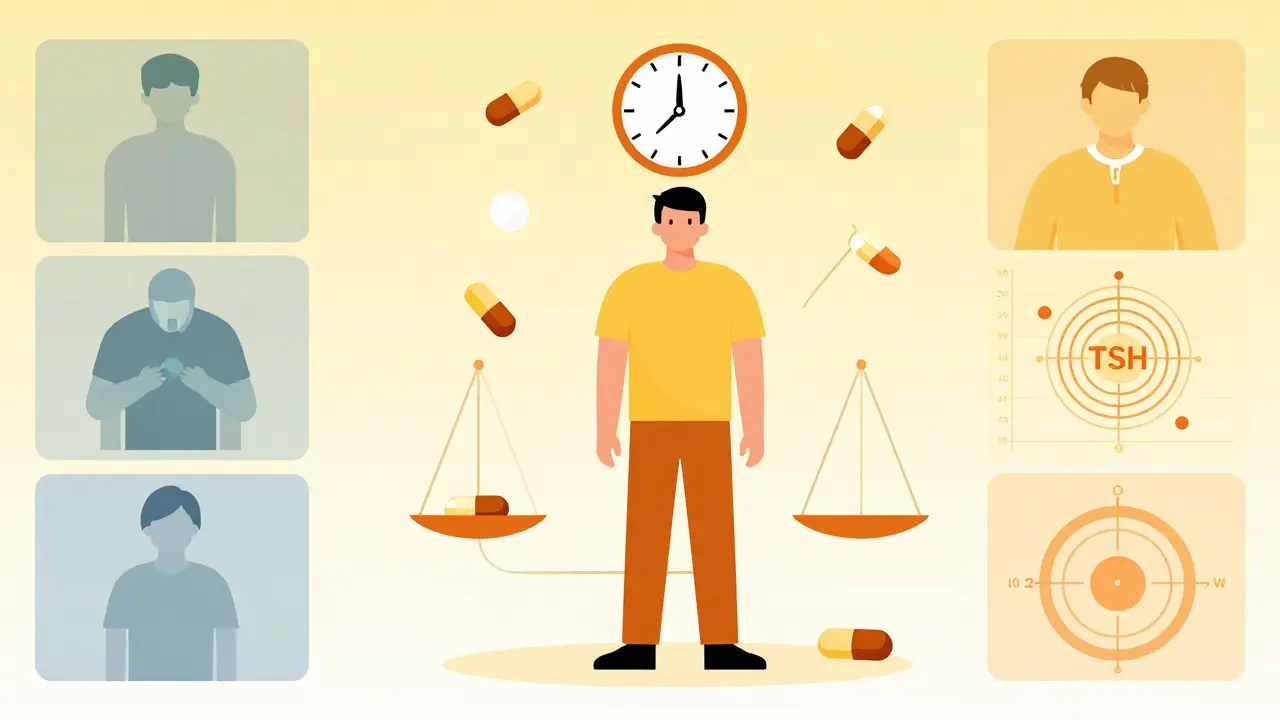
Timing is critical. After starting medication or changing your dose, you must wait 6 to 8 weeks before retesting. Why so long? Levothyroxine has a long half-life, and your body needs time to adjust its feedback loop. Testing earlier gives false results and leads to unnecessary dose changes. Once stable, annual testing is usually sufficient.

Treatment: Levothyroxine and Dosage Adjustments
The standard treatment for Hashimoto’s is hormone replacement therapy using levothyroxine (LT4). This synthetic version of T4 mimics your natural thyroid hormone. The brand name Synthroid dominates the market, but generic versions are equally effective if manufactured to strict FDA standards.
Dosage isn’t guessed; it’s calculated. A common starting point is 1.4 to 1.8 micrograms per kilogram of body weight for healthy adults. However, doctors often start lower (25-50 mcg/day) for elderly patients or those with heart issues to avoid stressing the cardiovascular system.
Adjusting the dose is a slow dance. Doctors typically change the dose by small increments-12.5 to 25 mcg-at each 6-8 week interval. You might feel better before your TSH looks perfect, or worse, you might feel fine while your TSH is technically "off." Always rely on the lab data combined with symptom tracking. Symptoms of too little medication include fatigue, weight gain, and cold intolerance. Too much medication causes anxiety, palpitations, insomnia, and unintentional weight loss.
Factors That Mess With Your TSH Levels
Even if you take your pill perfectly, external factors can skew your TSH results. Knowing these helps you interpret weird lab spikes or drops.
- Medications: Iron supplements, calcium, proton pump inhibitors (for acid reflux), and estrogen-containing birth control can block levothyroxine absorption. Take your thyroid med at least 4 hours apart from these.
- Weight Changes: Losing or gaining more than 10% of your body weight alters your hormone requirements. A significant weight drop usually means you need a lower dose.
- Pregnancy: Pregnancy dramatically increases thyroid hormone demand. If you have positive TPO antibodies, you need TSH testing every 4 weeks until 20 weeks gestation to prevent miscarriage or preterm birth.
- Lab Variability: Different labs use different assays. Stick to one laboratory for consistency. Switching labs can make your TSH appear to jump or drop without any real physiological change.
When TSH Isn’t Enough: Persistent Symptoms
Some patients hit a frustrating wall: their TSH is perfect (say, 2.0 mIU/L), but they still feel exhausted, brain-fogged, and depressed. This is known as "non-response" to standard therapy. While rare, it happens.
In these cases, endocrinologists might consider a few options:
- Optimizing TSH Lower: Titration toward the lower reference range (0.4-2.5 mIU/L) might help some patients feel better.
- Combination Therapy: Adding liothyronine (T3) to levothyroxine (T4) is controversial. A 2022 Cochrane Review found insufficient evidence to support routine T3 addition, but some specialists prescribe it off-label for patients who remain symptomatic despite optimal TSH.
- Genetic Factors: Recent studies suggest that people with specific DIO2 gene polymorphisms convert T4 to T3 poorly. These individuals might benefit from lower TSH targets or combination therapy.
Don’t self-prescribe T3. It has a short half-life and can cause dangerous heart rhythm issues if dosed incorrectly. Always work with an endocrinologist.
Practical Tips for Daily Management
Living with Hashimoto’s is manageable if you build good habits. Here is how to maximize your medication’s effectiveness:
- Morning Routine: Take levothyroxine on an empty stomach with water only. Wait at least 30-60 minutes before eating breakfast or drinking coffee.
- Consistency: Take your pill at the same time every day. If you miss a dose, take it as soon as you remember, unless it’s close to your next dose. Don’t double up.
- Track Symptoms: Keep a simple journal. Note energy levels, mood, weight, and sleep quality. This data is gold when discussing dose adjustments with your doctor.
- Avoid Soy: Large amounts of soy products can interfere with absorption. If you love tofu, try to space it out from your medication time.
Future Outlook: Personalized Medicine
The field of thyroid care is evolving. We are moving away from "one size fits all" toward personalized medicine. New guidelines are incorporating trimester-specific TSH targets for pregnancy, and research into genetic markers like DIO2 is helping explain why some patients struggle despite normal labs. Additionally, home TSH testing kits have received FDA approval, offering convenience, though experts still recommend lab-based testing for accuracy, especially at low TSH concentrations.
Hashimoto’s is a lifelong journey, but it doesn’t have to define your quality of life. By understanding the science behind TSH monitoring and advocating for your own health, you can find that sweet spot where your body feels like itself again.
How often should I get my TSH checked after starting levothyroxine?
You should get your TSH checked 6 to 8 weeks after starting levothyroxine or after any dose adjustment. This waiting period allows your body’s feedback mechanisms to stabilize. Once your TSH is within the target range and you feel well, testing can be reduced to once a year.
Can I cure Hashimoto’s thyroiditis naturally?
No, there is no cure for Hashimoto’s thyroiditis. It is a chronic autoimmune condition. While diet and lifestyle changes can support overall health and reduce inflammation, they cannot stop the immune system from attacking the thyroid. Hormone replacement therapy (levothyroxine) is necessary to replace the missing hormones.
Why does my TSH fluctuate even if I take my medication correctly?
TSH can fluctuate due to various factors including illness, stress, changes in weight, other medications (like iron or calcium), and even the time of day you take the test. Minor fluctuations are normal. Significant jumps usually indicate an issue with absorption or a need for dose adjustment.
Is it safe to take levothyroxine during pregnancy?
Yes, levothyroxine is safe and essential during pregnancy. Untreated hypothyroidism poses serious risks to fetal brain development. Pregnant women with Hashimoto’s often need higher doses and more frequent TSH monitoring (every 4 weeks initially) to maintain strict control.
Do I need to check my thyroid antibodies regularly?
No. Once Hashimoto’s is diagnosed via elevated TPO antibodies, repeating antibody tests is generally not needed. Antibody levels do not correlate well with disease activity or treatment success. Monitoring focuses on TSH and Free T4 levels instead.





This article is full of Western medical propaganda. In India, we manage thyroid issues with Ayurveda and natural herbs, not these synthetic drugs that create dependency. The US healthcare system is designed to keep you sick so they can sell you more pills. Wake up people! 🇮🇳
July 4Vinay Bairagi