
Imagine launching a sleek, minimalist brand identity in Tokyo and watching it flop, while the exact same design sells out in Stockholm. It’s not bad design-it’s culture. In brand psychology, we often assume that if a product works logically, people will accept it. But logic is local. What feels "clean" in one country might feel "cold" or even "dishonest" in another. This disconnect is at the heart of cultural acceptance, which refers to the systematic way cultural values, norms, and dimensions influence how individuals adopt new technologies, brands, or innovations. When you ignore these invisible rules, your best ideas die on the vine.
The Hidden Frameworks Behind Your Preferences
To understand why we accept or reject certain brand aesthetics, we have to look under the hood of human behavior. For decades, researchers relied on the Technology Acceptance Model (TAM), developed by Fred Davis in 1989, which suggests that users adopt technology based on perceived usefulness and ease of use. It’s a solid starting point, but it has a massive blind spot: it assumes everyone processes "usefulness" the same way. They don’t.
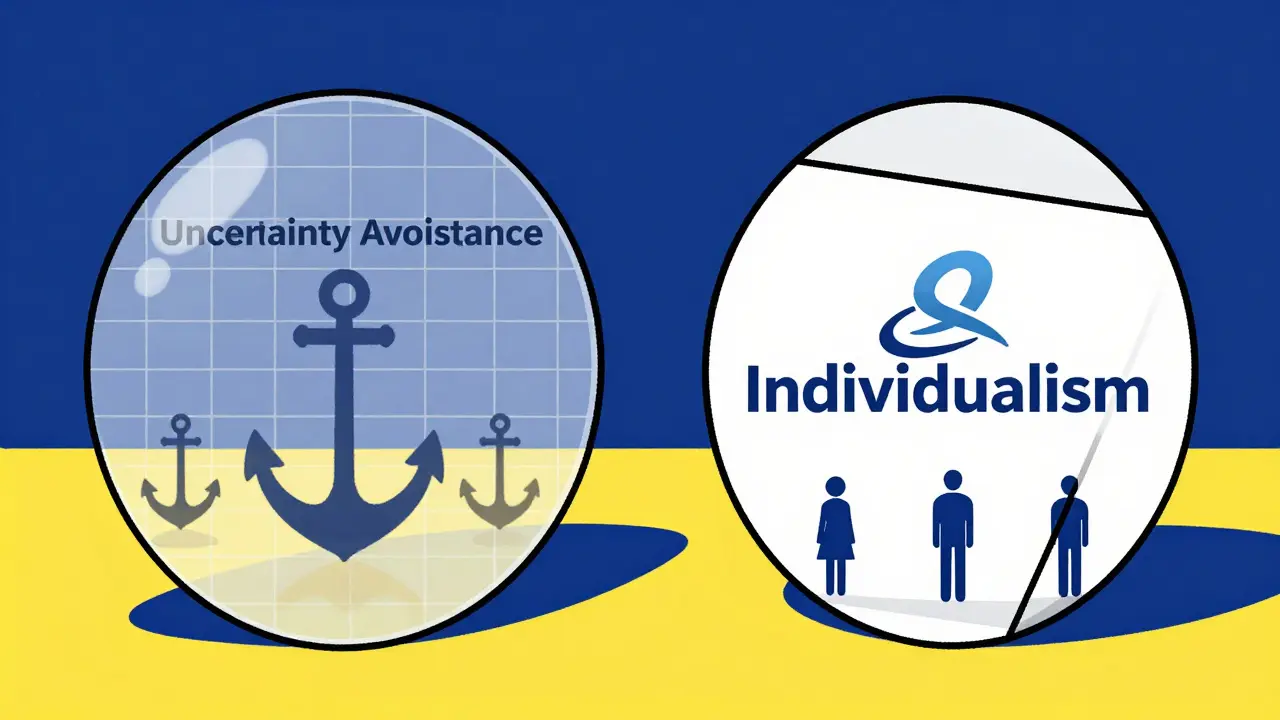
In 1980, sociologist Geert Hofstede introduced a framework identifying core cultural differentiators like power distance, uncertainty avoidance, individualism, and long-term orientation. His work revealed that culture isn't just about food or festivals; it’s a cognitive filter. When you combine TAM with Hofstede’s dimensions, the picture becomes clear. A study published in BMC Health Services Research (2022) found that uncertainty avoidance significantly impacts adoption rates (β = 0.37). In simple terms, people from high uncertainty avoidance cultures need more proof, more documentation, and less ambiguity before they trust a new brand. If your generic branding is too abstract, they won’t buy it-not because they don’t want it, but because they don’t trust it yet.
Why Generic Branding Fails Across Borders
Generic branding-stripping away logos, colors, and complex narratives to focus on pure utility-is booming in the West. It signals transparency and efficiency. But this aesthetic relies heavily on individualism and low power distance. In highly collectivist cultures, where group harmony and social proof drive decisions, a generic brand can look suspicious. Who are you? Why do you lack heritage? Without the social cues that signal status or belonging, the brand fails to connect.
Consider the difference between Sweden and Italy. Swedish consumers often value minimalism and functional honesty (low context communication). Italian consumers, influenced by higher masculinity-femininity dynamics and historical appreciation for craftsmanship, may view the same minimalist approach as lacking soul or quality. The 2022 BMC study noted that masculinity-femininity dimensions affect acceptance behaviors significantly (β = 0.29). In practice, this means that "generic" doesn't mean "universal." It means "culturally specific neutrality."
| Cultural Dimension | Brand Preference | Risk of Rejection |
|---|---|---|
| High Uncertainty Avoidance | Detailed specs, warranties, established heritage | Abstract or vague messaging |
| Collectivism | Social proof, community endorsements, group benefits | Lone-wolf or hyper-individualistic narratives |
| Low Power Distance | Transparent pricing, flat hierarchies, democratic tone | Pretentious luxury signaling without substance |
| Long-Term Orientation | Sustainability, durability, future-proofing | Flash-in-the-trend gimmicks |
The Cost of Ignoring Cultural Dispersion
Stefano Lambiase’s 2024 research, titled Dealing With Cultural Dispersion, highlights a critical gap in our current strategies. He found that fragmented knowledge leads to limited applicability for practitioners. In multinational software teams, ignoring cultural factors caused compatibility issues in 68% of implementations. Translate that to branding: if you launch a global campaign without assessing cultural dispersion, you’re likely miscommunicating with two-thirds of your audience.
The data is stark. Standard acceptance models explain 40% of variance in homogeneous markets but drop to just 22% in culturally diverse settings (Venkatesh et al., 2003). That 18% drop represents millions of dollars in wasted ad spend and lost market share. Conversely, organizations that design culturally sensitive implementation strategies see adoption rates jump by 23-47%. This isn’t just nice-to-have theory; it’s a bottom-line imperative.

Practical Steps to Adapt Your Brand Strategy
You don’t need to reinvent your brand for every country, but you do need to adapt its expression. Here is a practical, five-phase approach derived from industry best practices:
- Cultural Assessment (2-4 weeks): Use tools like Hofstede Insights’ Country Comparison Tool to map your target markets against key dimensions. Don’t guess; measure.
- Barrier Identification (1-2 weeks): Identify specific friction points. Does your "simple" UI feel "incomplete" to users in high-context cultures?
- Strategy Design (1-3 weeks): Adjust your messaging. For high uncertainty avoidance markets, add trust signals (certifications, detailed FAQs). For collectivist markets, highlight community usage.
- Implementation: Roll out localized versions. Note that healthcare professionals in Italy reported mixed results when EHR systems were culturally adapted-some loved the intuition, others hated the complexity. Test small first.
- Ongoing Monitoring: Culture shifts. Gen Z’s values change 3.2 times faster than previous generations (MIT, 2024). Your static strategy will become obsolete quickly.
A pro tip: High uncertainty avoidance cultures require 3.2 times more documentation for equivalent acceptance rates. If you’re selling a B2B SaaS tool to Germany versus Brazil, your German landing page needs more technical detail and compliance info to achieve the same conversion rate.
The Future of Cultural Intelligence
We are moving toward an era of AI-powered real-time cultural adaptation. By 2024, 32% of enterprises were piloting AI tools that adjust user interfaces and messaging based on real-time cultural dimension analysis. Microsoft’s Azure Cultural Adaptation Services, released in October 2024, is a prime example. These tools promise to reduce the 8-12 week assessment period that currently slows down projects by 15%.
However, beware of the "cultural flattening" effect. Global digital platforms are homogenizing tastes, especially among younger demographics. Dr. Nancy Howell warns that over-reliance on dimensional models risks stereotyping, as individual variation within cultures accounts for 70% of acceptance behaviors. The goal isn’t to stereotype nations; it’s to create flexible frameworks that respect deep-seated psychological triggers while allowing for individual nuance.
As we head into 2026, the companies that win won’t be those with the best products, but those with the deepest cultural empathy. They’ll understand that acceptance isn’t just about features-it’s about fitting into the mental model of the user.
What is the Technology Acceptance Model (TAM)?
The Technology Acceptance Model (TAM), developed by Fred Davis in 1989, is a theoretical framework that explains how users come to accept and use a technology. It posits that two main factors drive adoption: perceived usefulness (how much the tech improves performance) and perceived ease of use (how effortless it is to operate). While foundational, TAM often fails in cross-cultural contexts unless modified to account for cultural dimensions like uncertainty avoidance.
How does uncertainty avoidance affect brand acceptance?
Uncertainty avoidance refers to a society's tolerance for ambiguity. In high uncertainty avoidance cultures, consumers are risk-averse and seek clarity. They require more documentation, detailed specifications, and strong trust signals (like warranties or certifications) before accepting a new brand or product. Brands that rely on vague, abstract, or minimalist messaging often struggle in these markets because they fail to provide the necessary reassurance.
Why do generic brands sometimes fail in collectivist cultures?
In collectivist cultures, purchasing decisions are heavily influenced by group harmony, social proof, and relationships. A generic brand that emphasizes individual efficiency or lacks social cues (like testimonials, community stories, or heritage) can appear isolating or untrustworthy. Consumers in these regions often need to see how their peers or respected groups interact with the brand before feeling comfortable adopting it.
What is the 'Dealing With Cultural Dispersion' framework?
Introduced by Stefano Lambiase in 2024, this framework addresses the gap in existing theories by focusing on the practical challenges of cultural diversity in multinational teams. It identifies 14 specific cultural challenge categories and 9 benefit categories affecting acceptance. Unlike older models, it offers a socio-technical grounded approach, helping practitioners predict barriers and design strategies that increase adoption rates by up to 47%.
Is it worth the time to assess cultural differences for every launch?
Yes, especially for global or diverse domestic markets. While proper cultural analysis can delay projects by an average of 15% (adding 2-3 weeks to planning), the return on investment is significant. Meta-analyses show that culturally sensitive strategies boost adoption rates by 23-47%. Ignoring these factors often leads to higher churn, lower engagement, and costly rebrands later. The cost of failure is far higher than the cost of assessment.






Generic branding is just another excuse for lazy design. If you can't stand on your own two feet without cultural crutches, you're not a brand, you're a commodity.
May 10Amelia Vaughan