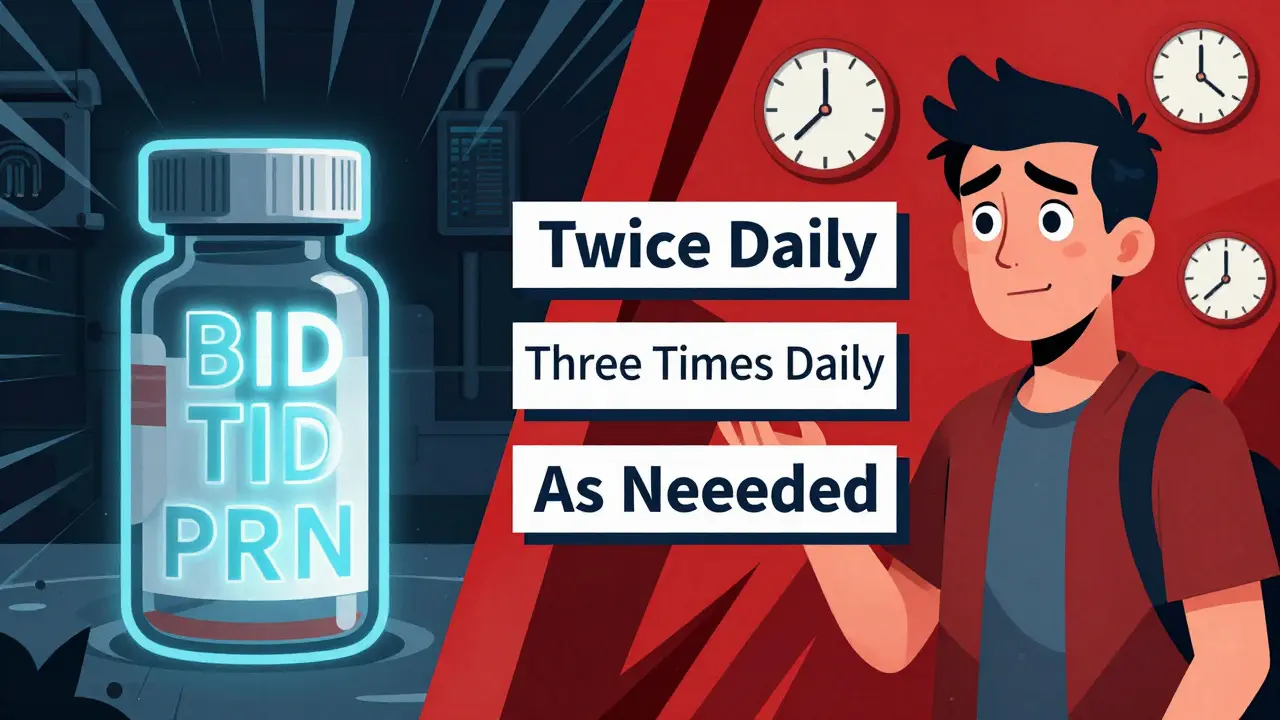
Ever looked at your prescription bottle and felt like you’re decoding a secret code? You’re not alone. BID. TID. PRN. These aren’t random letters-they’re Latin abbreviations that tell you exactly when to take your medicine. But if you’ve ever been confused about whether TID means three times a day or three times a week, you’re in good company. A 2023 Kaiser Family Foundation survey found that 68% of U.S. adults don’t fully understand what’s written on their prescription labels. That confusion can lead to missed doses, overdoses, or treatment failure. Here’s how to read those labels like a pro.
What BID, TID, and PRN Really Mean
BID stands for bis in die, which is Latin for "twice a day." That doesn’t mean morning and night-it means roughly every 12 hours. So if you take your first dose at 8 a.m., the second should be around 8 p.m. Skipping the evening dose or taking both at breakfast throws off your blood levels, especially with antibiotics or blood pressure meds.
TID means ter in die-"three times a day." This one trips up more people than any other. It doesn’t mean with breakfast, lunch, and dinner. It means every 8 hours. For example: 6 a.m., 2 p.m., and 10 p.m. A 2020 Mayo Clinic study showed that when patients spaced TID doses more than 2 hours apart from the recommended 8-hour window, drug effectiveness dropped by 38%. That’s not a small difference-it can mean the difference between clearing an infection or letting it get worse.
PRN is short for pro re nata, or "as needed." This sounds simple, but it’s the most misunderstood abbreviation. PRN doesn’t mean "take it whenever you feel like it." It means "take it only if you have the symptom listed, and only up to the maximum dose allowed." For example: "Ibuprofen 400mg PRN for pain, max 3 doses in 24 hours." That means you can take one pill when your headache starts, another 6 hours later if it’s still there, and one more after that-but no more than three total in a day. Taking four because "it didn’t help" can cause stomach bleeding or liver damage.
The Other Abbreviations You’ll See
There are 47 officially recognized prescription abbreviations in the U.S., but these are the ones you’ll actually see on your bottle:
- q.d. (quaque die) = once daily. Take it at the same time every day-morning is best for most meds.
- q.i.d. (quater in die) = four times daily. That’s every 6 hours: 6 a.m., 12 p.m., 6 p.m., 12 a.m.
- q.h. (quaque hora) = every hour. Usually followed by a number: q4h = every 4 hours.
- ac (ante cibum) = before meals. Take it 30-60 minutes before eating.
- pc (post cibum) = after meals. Take it within 30 minutes of finishing your meal.
- hs (hora somni) = at bedtime. Take it right before you go to sleep.
- po (per os) = by mouth. This is the most common route, so it’s often left off.
Some labels still use outdated or sloppy versions like "BID" without periods or "bid" in lowercase. That’s not illegal, but it’s confusing. The FDA and American Medical Association have been pushing for plain English since 2004, but change is slow.
Why These Abbreviations Still Exist
You might wonder: Why don’t they just write "twice daily"? The answer is history. In the early 1900s, doctors wrote prescriptions by hand on tiny pads. Latin abbreviations saved space and time. Even today, with electronic prescriptions, many doctors still use them out of habit. A 2022 survey found that 22% of physicians still write "BID" instead of "twice daily." And in 2023, 68% of U.S. prescriptions still included at least one Latin abbreviation, according to the FDA.
Pharmacies have been trying to fix this. Major chains like CVS and Walmart now print plain-English instructions on 74-78% of labels. But independent pharmacies? Only 41% do. That’s why your neighbor’s prescription might say "TID" while yours says "three times a day." It depends on where you filled it.
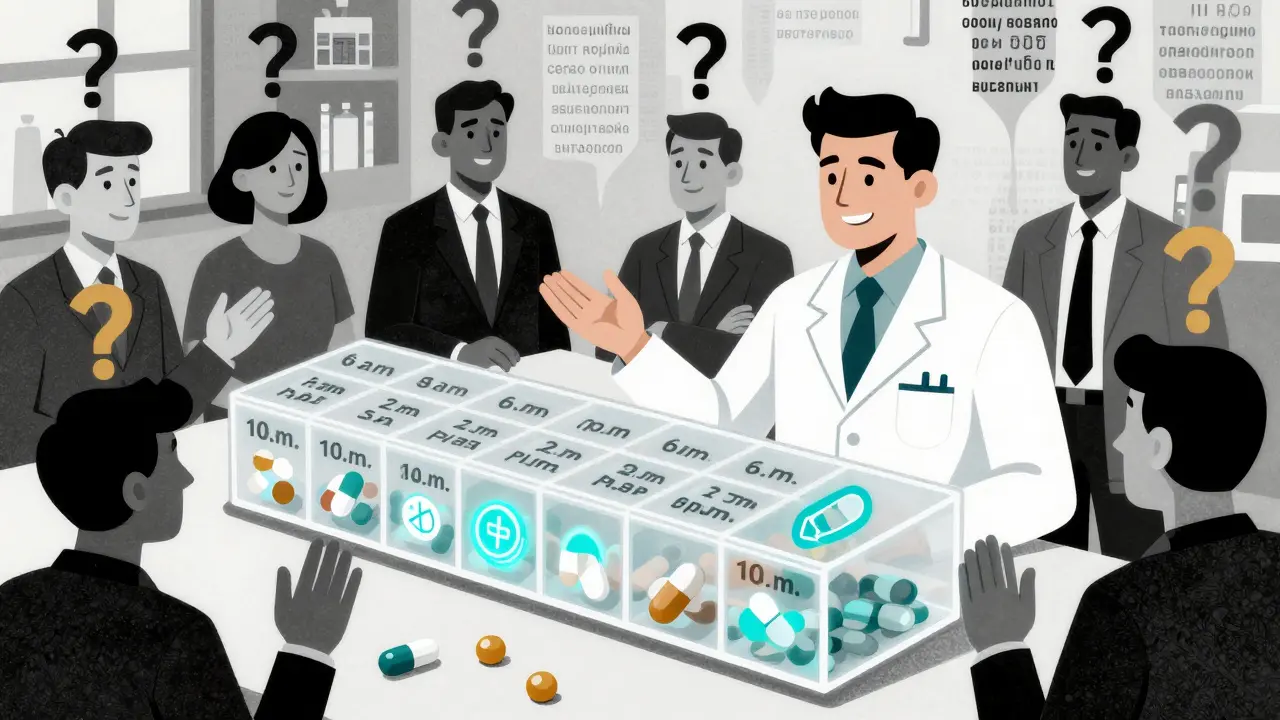
The Real Danger: Misunderstanding PRN and TID
PRN errors are the most common cause of medication mistakes. A 2021 FDA report showed PRN meds caused 31% of all dosing errors. Why? People think "as needed" means "whenever I want." One Reddit user shared how their grandmother took her TID antibiotic only at breakfast and dinner-thinking TID meant "three days." She finished the bottle in a week instead of 10 days, and the infection came back worse.
Another big problem: mixing up "TID" and "QID." One patient took a blood thinner QID (four times a day) thinking it was TID (three times). They ended up with dangerous bleeding and had to be hospitalized. These aren’t hypotheticals-they happen every day.
Even "once daily" can be risky. Some people take their blood pressure pill in the morning, but their doctor meant at night. That can cause their blood pressure to spike in the early hours, increasing heart attack risk. Timing matters.
How to Get It Right
You don’t have to memorize Latin. Here’s how to make sure you’re taking your meds correctly:
- Ask the pharmacist. They’re trained to explain this stuff. A 2022 Pharmacy Times survey found that 89% of patients felt much more confident after a pharmacist walked them through their label.
- Use the "teach-back" method. After the pharmacist explains, say: "So just to make sure I got it-you’re saying I take this pill at 7 a.m. and 7 p.m. every day?" If you can repeat it back, you’ll remember it.
- Use a pill organizer. Buy one with time slots labeled: Morning, Afternoon, Evening, Bedtime. A 2021 study in Annals of Internal Medicine found pill organizers improved adherence by 52%.
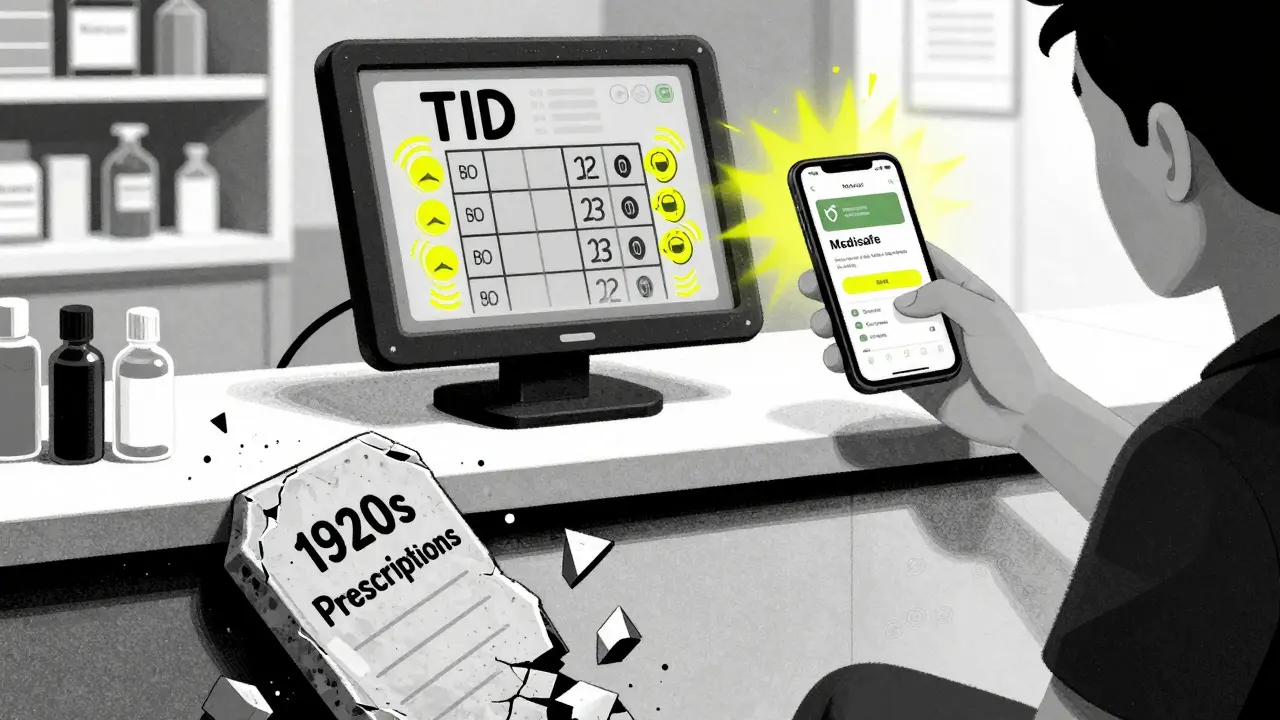
- Download a reminder app. Apps like Medisafe (used by over 18 million people) let you scan your prescription label. It automatically converts "BID" to "Take at 8 a.m. and 8 p.m." and sends you alerts.
- Do a "brown bag review." Once a year, bring all your pills-bottles, boxes, even the empty ones-to your doctor or pharmacist. They’ll spot duplicates, outdated meds, or mislabeled instructions.
What’s Changing-And What’s Coming
The good news? Change is happening. In 2023, the United States Pharmacopeia (USP) passed a new standard: all Latin abbreviations must be gone by December 31, 2025. Kaiser Permanente switched to plain English in 2022 and saw a 29% drop in patients calling to ask what their labels meant.
Next up: digital prescriptions will include automatic dosing calculators. If your doctor writes "TID," your pharmacy’s system will suggest exact times based on your daily routine-like "8 a.m., 4 p.m., 12 a.m."-and send them to your phone.
By 2027, experts predict fewer than 5% of U.S. prescriptions will use Latin abbreviations. But until then, you need to be your own advocate.
What to Do Right Now
Don’t wait for the system to fix itself. Here’s your action plan:
- When you get a new prescription, read the label out loud. If it says "BID," ask: "Does that mean every 12 hours?"
- If the label says "PRN," ask: "What symptom should I wait for? And what’s the max I can take in a day?"
- If the label is unclear, don’t guess. Call the pharmacy. Pharmacists expect these questions-they’ve heard them all before.
- Set phone alarms for your doses. Even if you think you’ll remember, your brain gets tired. Alarms save lives.
- Keep a written log of when you take your meds. It helps your doctor spot patterns if something goes wrong.
Medication safety isn’t about memorizing Latin. It’s about asking questions, using tools, and being clear. The system isn’t perfect-but you can be.
What does BID mean on a prescription?
BID means "bis in die," which is Latin for "twice a day." It should be taken approximately every 12 hours-for example, at 8 a.m. and 8 p.m. Taking both doses at once or at inconsistent times can reduce how well the medicine works.
Is TID the same as three times a day?
Yes, TID means three times a day, but it’s not just breakfast, lunch, and dinner. It means every 8 hours-like 6 a.m., 2 p.m., and 10 p.m. Spacing doses too far apart, like only taking them in the morning and at night, can lower the medicine’s effectiveness by up to 38%, according to Mayo Clinic research.
Can I take PRN meds whenever I want?
No. PRN means "as needed," but only for a specific symptom and within a set limit. For example, if your label says "Acetaminophen 500mg PRN for headache, max 3 doses in 24 hours," you can take one for a headache, but no more than three pills total in a day-even if you still have pain. Taking more can cause liver damage.
Why do pharmacies still use Latin abbreviations?
They’re a holdover from handwritten prescriptions, where space was limited. Even with electronic systems, many doctors still use them out of habit. While major chains like CVS and Walmart now print plain English, smaller pharmacies often don’t. The U.S. Pharmacopeia is requiring all Latin abbreviations to be eliminated by the end of 2025.
What should I do if I don’t understand my prescription label?
Call your pharmacy. Pharmacists are trained to explain prescriptions in plain language. Don’t be shy-89% of patients who asked for clarification said they felt more confident afterward. You can also ask your doctor during your next visit or use a pill organizer or medication app to help track doses.





so like... what if the whole system is just designed to keep us confused? i mean, why would they keep using latin if everyone's confused? maybe it's not about safety... maybe it's about control. 🤔
January 26Marian Gilan