Why Melanoma Detection Can’t Wait
Most people know melanoma is serious, but few realize how fast it kills. If caught early, the chance of surviving five years is over 99%. If it spreads, that number drops to 32%. That’s not a statistic-it’s the difference between life and death. And the window to catch it early? Often just weeks.
Every year, nearly 100,000 new melanoma cases are diagnosed in the U.S. alone. It’s not the most common skin cancer, but it’s responsible for nearly 80% of all skin cancer deaths. The problem isn’t lack of awareness-it’s delay. People ignore a mole that changes shape. They wait for it to bleed. They assume it’s just a freckle. By then, it might be too late.
How Melanoma Is Found Today
The old way was simple: look at your skin. A doctor checks for the ABCDE signs-Asymmetry, Border irregularity, Color variation, Diameter larger than 6mm, Evolving over time. But human eyes miss things. Studies show primary care doctors catch only 60-70% of melanomas. That’s nearly 1 in 3 slipping through.
Dermoscopy, a handheld magnifier with polarized light, helps. It’s standard in dermatology clinics. But even then, mistakes happen. That’s why new tools are stepping in-not to replace doctors, but to give them superpowers.
The New Tools: AI, Wearables, and Full-Body Scanners
AI isn’t science fiction anymore. It’s in clinics. One system, called SegFusion, developed at Northeastern University, combines image segmentation and deep learning to analyze skin lesions. It hits 99% accuracy in trials. That’s not luck. It’s because the system doesn’t just guess-it isolates the exact shape of the mole, then analyzes its texture, color, and edges. It’s trained on over 100,000 images, including ones from darker skin tones, which many older AI tools ignored.
Then there’s the wearable patch from Wake Forest. It’s battery-free, sticks to your skin like a Band-Aid, and measures electrical differences between healthy tissue and cancer. In early tests on 10 people, it spotted clear signals in melanoma lesions. Imagine checking your skin at home, no appointment needed. That’s the goal.
In Europe, the iToBoS project uses a full-body scanner that takes six minutes to map every mole on your body. It doesn’t just take pictures-it ranks each spot by cancer risk, flags changes from past scans, and explains its reasoning in plain terms. Doctors call it a “second pair of eyes.” Patients? They’re nervous. Some worry about privacy. Others love the idea of knowing for sure.
The Catch: False Alarms and Overdiagnosis
Not all new tools are perfect. One FDA-approved device, DermaSensor, uses light to scan moles. It’s great at spotting melanoma-95% sensitivity. But its specificity? Only 26-40%. That means for every 100 moles it flags as dangerous, 60-74 are harmless. That’s a lot of unnecessary biopsies, anxiety, and bills.
Some experts warn we’re heading into overdiagnosis territory. Not every mole that looks suspicious needs to be cut out. Some melanomas grow so slowly they’d never harm you. But we don’t know which ones. So we remove them all. That’s not always better. It’s just safer-for doctors, not always for patients.
And here’s the real issue: these tools work best on clear, well-lit photos from clinics. In real life? Lighting changes. Skin tones vary. Moles hide under hair or in folds. AI trained mostly on light skin struggles with darker skin. A 2025 JAMA Dermatology study found accuracy drops 12-15% on Black and Brown patients. That’s not acceptable. It’s a gap that must be fixed.
Immunotherapy: Turning the Body Into a Weapon
If melanoma spreads, the old answer-chemotherapy-was brutal and often useless. Now, immunotherapy has changed everything.
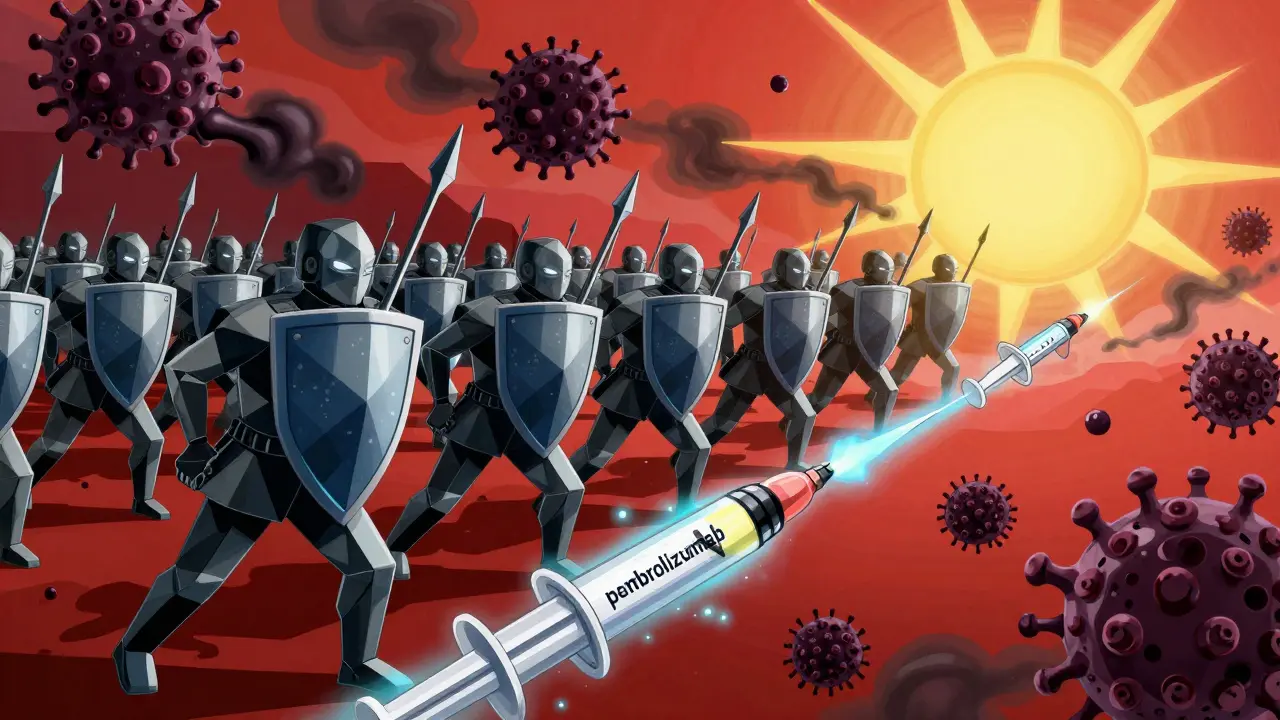
It doesn’t kill cancer directly. It wakes up your immune system. Melanoma hides from your body’s defenses. Immunotherapy drugs like pembrolizumab and nivolumab block the signals cancer uses to hide. Others, like ipilimumab, remove the brakes on immune cells. When used together, they can shrink tumors in half of advanced melanoma patients.
Some patients see complete remission. Their tumors vanish. And they stay gone for years. That’s rare with chemo. Now, it’s possible.
New drugs are coming fast. Regeneron’s fianlimab, combined with a PD-1 blocker, is showing promise in late-stage trials. Another, IMA203 PRAME cell therapy, triggered complete responses in over half of patients in early tests. These aren’t lab curiosities-they’re real treatments being used now.
What Works Best? Combination Is Key
Single immunotherapy drugs help. But combo therapy? That’s the gold standard now. Studies show combining anti-PD-1 and anti-CTLA-4 drugs boosts survival by 20-30% compared to one drug alone. The trade-off? More side effects. Fatigue. Diarrhea. Liver inflammation. But for many, it’s worth it.
Doctors now test tumors for specific mutations-BRAF, NRAS, KIT-before choosing treatment. If you have a BRAF mutation, you might get targeted therapy instead. But for most, immunotherapy comes first. It lasts longer. It works even when targeted drugs fail.
What’s Next? The Future Is Personal
The next big leap isn’t just better scanners or new drugs. It’s personalization. Imagine a test that combines:
- A full-body scan of your moles
- A blood test for immune markers
- Your genetic profile
- Your past sun exposure and family history
An AI then gives you a risk score-and a plan. Maybe you need a biopsy. Maybe you need a monthly patch check. Maybe you’re low risk and just need yearly checks. No more guesswork.
Some clinics are already doing this. Mayo Clinic and Cleveland Clinic now use AI to reduce unnecessary biopsies by 28%. That’s not just saving money. It’s saving stress.
What You Can Do Right Now
You don’t need a scanner or a drug trial to protect yourself.
- Check your skin monthly. Use a mirror. Look at your back, scalp, between toes, under nails.
- Know your ABCDEs. If something changes-size, color, shape, itchiness-get it checked.
- Don’t wait for a doctor to find it. You’re the first line of defense.
- If you have a family history of melanoma, or more than 50 moles, get a full-body skin exam yearly.
- Wear sunscreen daily. Not just at the beach. UV damage adds up.
And if your doctor dismisses a mole you’re worried about? Get a second opinion. Melanoma doesn’t care if you’re busy, scared, or broke. It moves fast.
Final Thought: It’s Not About Technology Alone
The best AI in the world won’t help if you ignore a new spot. The most powerful drug won’t work if you wait too long. Technology is a tool-not a replacement for awareness.
Early detection saves lives. Immunotherapy gives hope. But both need you to act.
Can melanoma be cured if it’s caught early?
Yes. When melanoma is caught before it spreads beyond the skin, the five-year survival rate is over 99%. Early removal through a simple biopsy is often all that’s needed. That’s why regular skin checks and prompt attention to changing moles are critical.
How effective is immunotherapy for advanced melanoma?
For advanced melanoma, immunotherapy works in about 40-60% of patients. Combination therapies (like anti-PD-1 + anti-CTLA-4) improve response rates and survival compared to single drugs. Some patients achieve long-term remission-meaning no signs of cancer for five years or more. It’s not a cure for everyone, but it’s transformed a once-deadly diagnosis into a manageable condition for many.
Are AI skin scanners reliable?
AI tools like SegFusion and iToBoS are highly accurate in clinical trials, with some reaching 99% sensitivity. But they’re not perfect. False positives are common, especially with lower-specificity devices like DermaSensor. They’re best used as tools to support, not replace, a dermatologist’s judgment. Always follow up any AI alert with a professional evaluation.
Do these new detection tools work on darker skin tones?
Historically, many AI models were trained mostly on light skin, leading to lower accuracy on darker skin tones-up to 15% worse in some cases. Newer systems like SegFusion are being retrained with diverse datasets to fix this. But not all commercial tools have caught up. If you have darker skin, insist on a full clinical exam, not just a scan. Visual inspection by a trained dermatologist remains essential.
Is immunotherapy right for everyone with melanoma?
No. Immunotherapy works best for patients whose tumors express certain markers and who are otherwise healthy enough to handle side effects. Doctors test tumors for BRAF, PD-L1, and other markers before deciding. Some patients respond better to targeted therapy or surgery. Treatment is personalized. Never assume immunotherapy is automatic-it’s one tool among many.
What’s the biggest mistake people make with melanoma?
Waiting. People often ignore a mole until it bleeds, itches, or grows fast. But melanoma can spread before it causes symptoms. The biggest mistake is assuming it’s harmless because it doesn’t hurt. If it looks different from your other moles-or changes over weeks or months-get it checked. Don’t wait.







i just checked my arm and noticed a mole i never paid attention to... it's kinda asymmetrical now. i'm gonna make an appt tomorrow. thanks for the nudge.
January 30i know i should've done this sooner. sorry i'm late to the game.
Rachel Liew